

Learn what telehealth urgent care can treat, how much it costs, insurance coverage, and when an in-person visit is the better choice.
It's 9 p.m., you've got a scratchy throat and a fever that won't quit, and the idea of sitting in a waiting room for two hours sounds worse than the illness itself. This is exactly the situation telehealth urgent care was built for.
It lets you talk to a licensed medical provider over video or phone, get a diagnosis, and walk away with an e-prescription all without putting on real pants.
But telehealth urgent care isn't a replacement for every trip to the doctor, and knowing where the line sits is what actually saves you time and money. This guide breaks down what it treats, what it costs, what the rules are, and when you should just go in person instead.
What Is Telehealth Urgent Care?
Telehealth urgent care is a virtual visit with a doctor, nurse practitioner, or physician assistant for a non-emergency illness or minor injury. You connect through an app or website, describe your symptoms, and the provider assesses you the same way they would in an exam room, just without the physical exam.
It sits in a specific lane: more immediate than primary care telehealth, and less intensive than in-person urgent care. A typical visit takes 10 to 20 minutes. You check in, answer a few intake questions, wait for a provider, and by the end of the call you usually know whether you need a prescription, home care instructions, or a referral to be seen in person.
The appeal is obvious: no commute, no waiting room, and availability that often stretches into evenings, weekends, and holidays. The catch is just as important: a camera can't run a strep test or take an X-ray, so telehealth urgent care only works for conditions that don't need hands-on diagnostics.

What Conditions Can Telehealth Urgent Care Actually Treat?
This is where most guides get vague. Here's a clearer breakdown.
Conditions Telehealth Handles Well
Cold and flu symptoms
Sinus infections
Urinary tract infections (UTIs)
Pink eye
Mild skin rashes and allergic reactions
Seasonal allergies
Sore throat (when strep isn't suspected or a rapid test isn't required)
Prescription refills for ongoing minor conditions
Conditions That Need In-Person Urgent Care or the ER
Suspected fractures or sprains that may need an X-ray
Deep cuts that may need stitches
Severe dehydration
Suspected appendicitis or abdominal pain that's getting worse
Chest pain, difficulty breathing, or signs of stroke (call 911, don't book a video visit)
High fever in an infant under three months
Decision Checklist
Symptom | Telehealth OK? | Why |
Sore throat, no trouble swallowing | Yes | Visual + symptom-based assessment usually enough |
Suspected broken bone | No | Needs imaging |
UTI symptoms | Yes | Common, easily diagnosed by symptoms |
Chest pain | No | Call 911 |
Pink eye | Yes | Visually diagnosable on camera |
Deep laceration | No | Needs in-person wound care |
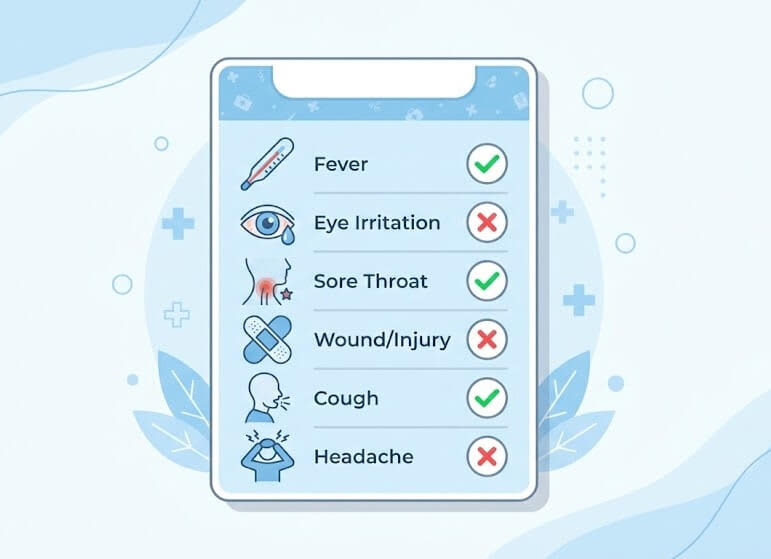
If you're ever unsure, most telehealth urgent care platforms will tell you upfront that a provider can always redirect you to in-person care if your symptoms require more than a video visit can offer. Building a home backup plan for the nights you can't get seen at all? Check our urgent care kit guide for exactly what to stock.
How Much Does Telehealth Urgent Care Cost in 2026?
Cost is where telehealth urgent care genuinely outperforms traditional options, but the numbers vary more than people expect depending on how you're paying.
Cash-Pay Pricing
Without insurance, a telehealth urgent care visit typically costs somewhere between $40 and $130, with most platforms landing closer to $70–$90. Flat-fee, no-membership services tend to sit at the lower end of that range.
Insured Pricing
If your insurance covers telehealth, expect a copay between $0 and $50, similar to what you'd pay for a regular primary care visit. Not all insurers cover every telehealth platform, though, so it's worth confirming before you book; some plans only cover telehealth through a specific in-network provider.
Membership Models
Some services offer annual memberships, usually $100–$200 per year, that include unlimited urgent care visits for minor conditions. This can make sense if your household uses telehealth regularly.
Telehealth vs. Urgent Care vs. ER: Cost
Care Type | Typical Cash-Pay Cost |
Telehealth urgent care | $40–$130 |
In-person urgent care | $150–$280+ |
Emergency room (non-emergency use) | $1,000–$2,700+ |
Research comparing billed charges across large patient samples has found telemedicine visits can cost roughly five times less than an equivalent in-person visit for the same condition. For acute, uncomplicated issues like UTIs, sinus infections, pink eye, there's typically no clinical downside to that savings. Source: Penn Medicine / JAMA Network Open study
Is Telehealth Urgent Care Covered by Insurance?
Coverage depends entirely on your plan and the platform you use. Some insurers have expanded telehealth benefits significantly in recent years; others have quietly stopped covering certain providers altogether. Before booking, it's worth a two-minute check:
Is this specific telehealth urgent care platform in-network?
Does your plan apply a copay, coinsurance, or full cost to virtual visits?
Are there restrictions based on the reason for your visit?
Skipping this step is the most common reason people get an unexpected bill after what they assumed was a covered visit. Don't have insurance at all? See our full breakdown of how urgent care billing works without insurance, including negotiation tactics and hardship programs.
State Rules and Prescribing Limits You Should Know
This part rarely gets covered, but it matters. Telehealth providers must be licensed in the state where you're physically located during the visit, not where you live, and not where the company is headquartered. If you're traveling out of state when you get sick, your usual telehealth urgent care provider might not be able to see you.
Prescribing controlled substances via telehealth has its own and currently shifting set of rules. The DEA and HHS have issued repeated temporary extensions of the pandemic-era flexibilities that allow providers to prescribe Schedule II–V controlled substances via telehealth without a prior in-person visit.
The most recent extension runs through December 31, 2026, while the DEA finalizes permanent regulations. That means the flexibility exists today, but it's explicitly temporary and could tighten once permanent rules are issued.
Don't assume a video visit will automatically result in the same controlled-substance prescription you'd get in person, especially for medications tied to pain management or certain psychiatric conditions. Source: Telehealth.HHS.gov – Licensing Across State Lines
What Actually Happens During a Telehealth Urgent Care Visit?
Here's the honest walkthrough, not the marketing version.
Check-in: You fill out a short intake form with symptoms, duration, medical history, and current medications.
Wait: Most platforms quote wait times under 15–20 minutes, though this varies by time of day.
The visit: The provider asks questions, may ask you to show something on camera (a rash, your throat, a swollen area), and makes an assessment based on what they can see and what you describe.
The outcome: You get one of three results: a diagnosis and treatment plan, an e-prescription sent to your pharmacy, or a referral to be seen in person if your symptoms need something a camera can't provide.
The honest limitation here is that the exam is only as good as what's visible and describable. No labs, no imaging, no physical palpation. Good providers are upfront about this and will redirect you rather than guess.

Telehealth Urgent Care vs. In-Person Urgent Care: Pros and Cons
When Telehealth Wins
Minor, common conditions with clear visual or symptom-based diagnosis
After-hours or weekend needs
Cost sensitivity cash-pay or high-deductible plans
Convenience for people with mobility limits or no easy transportation
When In-Person Wins
Anything needing imaging, labs, or a physical exam
Injuries with visible trauma
Situations where symptoms are worsening or unclear
Young infants or complex medical histories
Neither option replaces the other; they solve different problems. The mistake is treating telehealth urgent care as a universal substitute instead of a specific tool for specific situations.

How to Choose the Right Telehealth Urgent Care Provider
A few things separate a solid telehealth urgent care platform from a mediocre one:
License verification: Providers should be board-certified and licensed in your state.
Transparent pricing: You should see the cost before you book, not after.
Clear scope: Good platforms list exactly what conditions they treat and what they don't.
Response time: Look for stated average wait times, not vague fast claims.
Insurance clarity: They should tell you upfront whether they accept your plan.
Red flags include hidden pricing, no visible licensing information, or vague claims about what conditions can be treated.
Is telehealth urgent care as good as in-person urgent care?
For minor, common conditions, yes, it's just as effective and considerably faster. For anything needing imaging, labs, or a hands-on exam, in-person care is the better choice.
Can telehealth urgent care prescribe antibiotics?
Yes, when appropriate for the diagnosed condition. Controlled substances face additional restrictions that vary by state.
How fast can you get seen through telehealth urgent care?
Most platforms report average wait times under 20 minutes, though this can vary based on time of day and demand.
Does telehealth urgent care work without insurance?
Yes. Cash-pay visits typically range from $40 to $130, often cheaper overall than an uninsured in-person urgent care visit.
Can telehealth urgent care treat a child?
Many platforms do, often with an age minimum and a parent or guardian required to be present during the visit. Check the specific platform's policy.
Conclusion
Telehealth urgent care is genuinely useful, cheaper, faster, and available when your regular doctor isn't. The key is matching it to the right situation: minor, common, visually or symptomatically diagnosable conditions.
For anything involving imaging, lab work, or a worsening physical injury, in-person urgent care or the ER is still the right call. Know the line, and telehealth urgent care becomes one of the most efficient tools in your healthcare routine, not a gamble on getting the right diagnosis.
Related Posts



Comments (0)
Comments are disabled for this post.