

Improve GI billing accuracy, reduce denials, and navigate payer rules for faster, more reliable reimbursement.
Gastroenterology billing services cover the coding, claims submission, and revenue cycle work behind every colonoscopy, endoscopy, and GI office visit. This includes verifying insurance, applying the correct CPT and ICD-10 codes, managing denials, and following up on unpaid claims until they're resolved.
Done well, gastroenterology billing keeps cash flow steady and reduces the administrative burden on physicians. Done poorly, it leads to denied claims, delayed payments, and unexpected bills for patients. Small coding mistakes, like a missing modifier on a converted colonoscopy, can turn into thousands of dollars in lost revenue over a year.
What Are Gastroenterology Billing Services?
Gastroenterology billing services handle the financial side of a GI practice. That includes coding procedures, submitting claims, verifying insurance, managing denials, and recovering unpaid balances.
Together, these tasks make up gastroenterology revenue cycle management, or GI RCM. The goal is simple: get every service coded correctly and paid on time.
GI billing differs from general medical billing in one key way. Gastroenterology practices perform a high volume of procedures, and many of those procedures carry strict bundling and modifier rules. A single coding error on a colonoscopy claim can trigger a denial that takes weeks to resolve.
Why Gastroenterology Billing Is More Complex Than General Medical Billing
Most specialties bill for office visits and a handful of common procedures. Gastroenterology bills for dozens of endoscopic procedures, each with its own documentation and coding requirements.
High Procedure Volume and Bundling Rules
GI practices perform screening colonoscopies, diagnostic colonoscopies, EGDs, and biopsies, often on the same day for the same patient. Medicare's multiple endoscopy reduction rule then applies. This rule reduces payment for the second and third procedures performed during the same session. Source: CMS
Coders must know which codes bundle together and which don't. Miss this, and the claim either underpays or gets denied for duplicate billing.
Screening vs. Diagnostic Colonoscopy Billing
This is the single most misunderstood part of gastroenterology billing, and it directly affects both the practice and the patient.
Here's how it works. A patient comes in for a routine screening colonoscopy, which many insurance plans cover at 100% under preventive care rules. During the procedure, the physician finds and removes a polyp. The moment that happens, the procedure is no longer purely preventive. It becomes diagnostic or therapeutic.
The claim must reflect that shift. Coders apply modifier PT for Medicare claims, which signals a screening service that became diagnostic. For commercial payers, modifier 33 often applies to preserve preventive cost-sharing where state or plan rules allow it.
Get this wrong, and one of two things happens. Either the claim gets denied for a mismatch between diagnosis and procedure code, or the patient receives an unexpected bill for a service they thought was fully covered. Both outcomes hurt the practice's reputation and collections.
Facility vs. Professional Fee Billing
When a GI procedure happens in a hospital or ambulatory surgery center, two separate claims get generated. The facility bills for the space, equipment, and staff. The physician bills separately for their professional service.
These two claims must align on procedure codes and dates of service. A mismatch between the facility claim and the professional claim is a common, preventable cause of denials. Practices that bill in ASC settings need staff who understand both sides of this split.
Key CPT and ICD-10 Codes Used in Gastroenterology Billing
Accurate coding starts with knowing which code families apply to which procedures.
Common GI CPT Code Ranges
Colonoscopy procedures generally fall in the 45378–45398 range, covering everything from diagnostic colonoscopy to polypectomy and lesion removal. Upper endoscopy procedures, including EGD, fall in the 43235–43259 range. ERCP and capsule endoscopy each have their own distinct code sets outside these ranges. Source: AMA
Each code within these ranges reflects a specific technique, such as biopsy, snare removal, or hot forceps ablation. Using the wrong code within the right range still triggers a denial or an underpayment.
Modifiers That Matter in GI Claims
A handful of modifiers show up constantly in gastroenterology claims:
Modifier 33: Identifies a preventive service, used to preserve no-cost-sharing status
Modifier PT: Flags a screening colonoscopy that became diagnostic, for Medicare claims
Modifier 59 or XU: Indicates a distinct, separately identifiable procedural service
Modifier 25: Applies when an E/M visit happens on the same day as a procedure
Applying these correctly prevents most bundling-related denials before they happen.
ICD-10-CM Coding for GI Conditions
Screening procedures use Z-codes, such as Z12.11 for colorectal cancer screening. Diagnostic procedures require a code that matches the clinical reason for the visit, such as codes for GERD, IBD, IBS, or liver disease. Source: CDC
The diagnosis code must support the CPT code billed. A screening Z-code paired with a diagnostic CPT code is a documentation red flag that payers catch quickly.
Common Denial Reasons in Gastroenterology Billing and How to Prevent Them
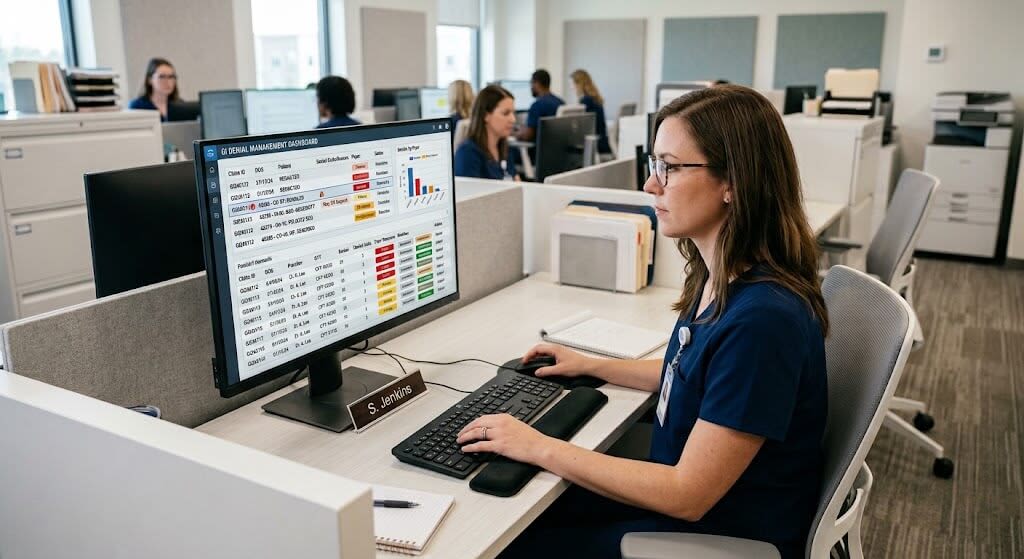
Understanding denial codes helps practices fix problems at the source instead of appealing after the fact.
Top GI Denial Codes to Know
CO-97: The service is bundled into another already-paid procedure
CO-50: The payer considers the service not medically necessary
CO-197: Prior authorization was missing or incomplete
Each of these points to a specific fix. CO-97 usually means a modifier was missing. CO-50 usually means the diagnosis code didn't support medical necessity. CO-197 means the authorization step was skipped or expired before the procedure date.
Prior Authorization Pitfalls Specific to GI Procedures
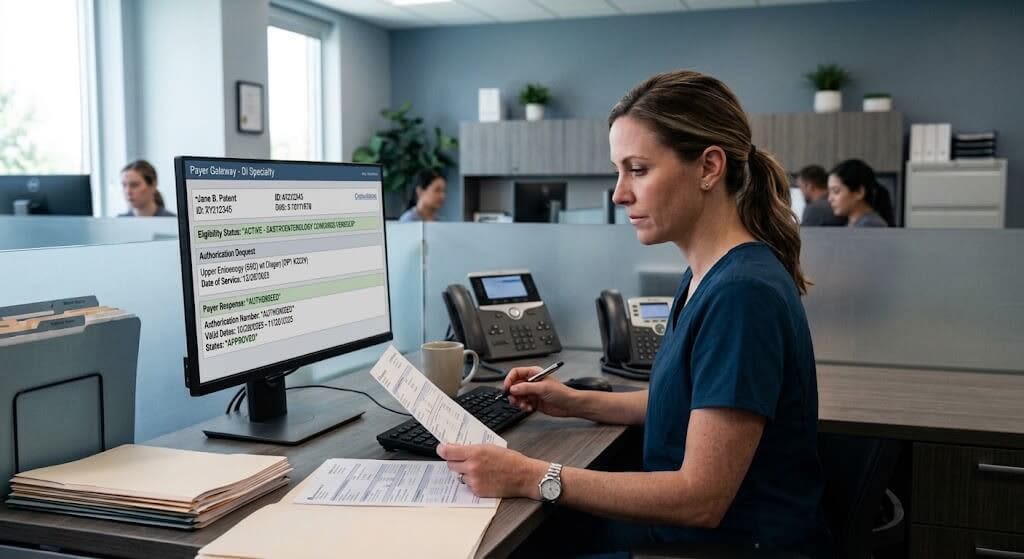
Not every GI procedure requires prior authorization, but many advanced ones do, including certain capsule endoscopies and ERCPs. Authorization requirements also vary by payer and by plan type, even within the same insurance company.
Practices that verify authorization requirements before scheduling avoid same-day cancellations and post-procedure denials.
Documentation Requirements for GI Procedures
Most denials trace back to documentation gaps, not coding mistakes. Fixing documentation prevents the CO-97 and CO-50 denials covered above.
What Payers Require in Colonoscopy/EGD Documentation
Payers expect the procedure note to include the indication for the procedure, the extent of the exam, findings, and any tissue removed or biopsied. Time-based codes also require documented start and stop times.
Missing even one of these elements gives the payer grounds to deny or downcode the claim. A complete note protects the claim before it's even submitted.
Medical Necessity Documentation for GI Diagnostic Tests
The clinical note must justify why the test was ordered. Vague language like "routine follow-up" rarely satisfies medical necessity requirements for diagnostic testing.
This connects directly to the screening-versus-diagnostic issue covered earlier. If a patient has symptoms, the visit isn't a screening, and the documentation must say so clearly. Mismatched documentation is one of the fastest ways to trigger a CO-50 denial.
In-House vs. Outsourced Gastroenterology Billing: What It Actually Costs
This decision comes down to cost, control, and capacity. There's no universal right answer, but the numbers help clarify the tradeoffs.
Typical Pricing Models
Outsourced gastroenterology billing companies typically charge in one of two ways. Percentage-of-collections models usually range from 4% to 9% of monthly collections, depending on practice size and service scope. Flat per-provider fees are less common but offer predictable monthly costs regardless of collection volume.
In-house billing costs include billing staff salaries, coding software licenses, clearinghouse fees, and ongoing training. A single experienced medical biller typically costs a practice well beyond their base salary once benefits and software are factored in.
When Outsourcing Makes Sense vs. When It Doesn't
Outsourcing tends to make sense for smaller practices without the volume to justify a full-time, specialized GI coder. It also helps practices experiencing high denial rates that need immediate expertise. Not sure which model fits your practice? Reach out for a free consultation.
In-house billing can make more sense for larger, multi-provider practices with the volume to justify dedicated staff and the infrastructure to support them. The deciding factor is usually whether the practice has enough claim volume to keep specialized staff fully utilized.

Technology and Automation in Gastroenterology Billing
Software now plays a larger role in GI billing accuracy than it did even a few years ago.
EHR/EMR Integration for GI Practices
When billing software connects directly to a practice's EHR, procedure notes flow straight into the coding workflow. This reduces manual data entry errors and speeds up claim submission.
Poor integration creates the opposite effect. Staff re-enters data manually, and transcription errors slip into claims. Practices evaluating a billing partner should ask specifically how their systems integrate with the practice's existing EHR.
AI-Assisted Coding: What It Can and Can't Do
AI-assisted coding tools scan procedure notes and suggest CPT and ICD-10 codes automatically. This speeds up the coding process and flags obvious mismatches, like a screening code paired with a diagnostic note.
What AI can't yet do reliably is judge clinical nuance the way an experienced coder can. Edge cases, like a screening colonoscopy that becomes diagnostic mid-procedure, still need human review. The most effective setups use AI to handle routine coding and reserve human coders for complex or ambiguous cases.
Medicare and Payer-Specific Rules for GI Procedures
Reimbursement rules aren't uniform across payers, and treating them as if they were causes avoidable denials.
Medicare's Screening Colonoscopy Policy
Medicare covers screening colonoscopies at no cost to the patient when no polyp is found. If a polyp is removed during the same screening, coinsurance still applies, though it's being phased out gradually. For dates of service in 2023 through 2026, that coinsurance is 15%. It drops to 10% for 2027 through 2029, then reaches 0% starting in 2030. Source: Noridian Medicare
Practices still need to code correctly even though the coinsurance amount is now lower than it used to be. Medicare requires the PT modifier to track that a screening became diagnostic, and this modifier directly determines how much the patient owes.
How Commercial Payers Differ
Commercial payers don't automatically follow Medicare's no-cost-sharing rule for converted colonoscopies. Some plans waive cost-sharing entirely, following Affordable Care Act preventive service rules. Others still apply a copay or coinsurance once a polyp is removed, depending on the specific plan.
This is why verifying benefits before the procedure matters as much as coding it correctly afterward. A practice that checks payer-specific policy before scheduling avoids most patient billing disputes.
2026 Coding and Regulatory Updates Affecting Gastroenterology Billing
CPT and ICD-10 code sets are updated annually, and gastroenterology sees regular changes to endoscopy and biopsy codes. Practices should confirm current-year updates directly through CMS and AMA before finalizing any coding workflow, since code sets can shift procedure descriptions or bundling edits from one year to the next.
Staying current also means training billing staff whenever a new code year takes effect. A single missed update can cause a wave of denials across an entire quarter.
Signs of Strong GI Billing Performance
Practices need a way to measure whether their billing process is actually working. A few benchmarks help:
Clean claim rate: Well-run GI practices typically submit 90% or more of claims without errors on the first pass.
Days in AR: A healthy target is under 40 days from claim submission to payment.
Denial rate: Strong-performing practices keep denial rates under 8%, though rates above 10% signal a process problem worth investigating.
Tracking these numbers monthly makes it easy to spot a declining trend before it becomes a cash flow problem.
How much do gastroenterology billing services cost?
Most outsourced gastroenterology billing services charge 4% to 9% of monthly collections. Flat-fee models exist but are less common. In-house billing costs vary based on staff salary, software, and training.
What's the difference between screening and diagnostic colonoscopy billing?
A screening colonoscopy is preventive and often fully covered. If a polyp is found and removed, the procedure becomes diagnostic. This shift changes the CPT modifier used and can affect patient cost-sharing, depending on the payer.
Should a small GI practice outsource billing?
Smaller practices without enough volume to justify a dedicated, specialized coder often benefit from outsourcing. It provides access to GI-specific expertise without the overhead of a full-time hire.
What CPT codes are most commonly denied in gastroenterology?
Colonoscopy and EGD codes with bundling or modifier errors, particularly around screening-to-diagnostic conversions, generate a large share of GI denials.
Can AI replace human coders in GI billing?
Not entirely. AI handles routine, straightforward coding well but still struggles with clinical nuance, such as judgment calls on converted procedures. Human review remains necessary for complex cases.
Related Posts



Comments (0)
Comments are disabled for this post.