

Interested in how urgent care practices themselves manage billing more efficiently? See our urgent care billing services for practices and providers.
You walked into urgent care feeling terrible, got treated, and walked out, and maybe paid nothing at the desk. Now you're wondering: will I get a surprise bill in the mail? And if I do, what happens if I can't pay it?
These are real fears. Medical debt remains one of the leading drivers of personal bankruptcy in the U.S., and uninsured patients are the most vulnerable to unexpected bills. (Source: Consumer Financial Protection Bureau)
How Major Urgent Care Chains Handle Uninsured Billing?
Generic cost ranges don't tell you what AFC Urgent Care or CityMD will actually do when you walk in without insurance. Here is a breakdown based on verified 2026 policies (call ahead to confirm, as policies and location-specific rates change):
Chain | Billing Policy | Self-Pay Discount? |
AFC Urgent Care | Payment due at visit; self-pay X-rays $100–$280 | Yes, discounted cash pricing |
CityMD | Payment at check-in; self-pay fee ~low-to-mid $200s | Yes, competitive uninsured rate |
MedExpress (WVU Medicine) | Payment due at visit; flat self-pay fee, lower with hardship review | Yes, plus hardship discount |
FastMed Urgent Care | Payment due at visit; flat self-pay rate, no insurance combo | Yes, published flat rate |
GoHealth Urgent Care | Payment due at visit; self-pay ranges $120–$350+ by region | Yes, dedicated self-pay tier |
Source: Verified via individual chain self-pay pricing pages.
What Happens If You Can't Pay Your Urgent Care Bill?
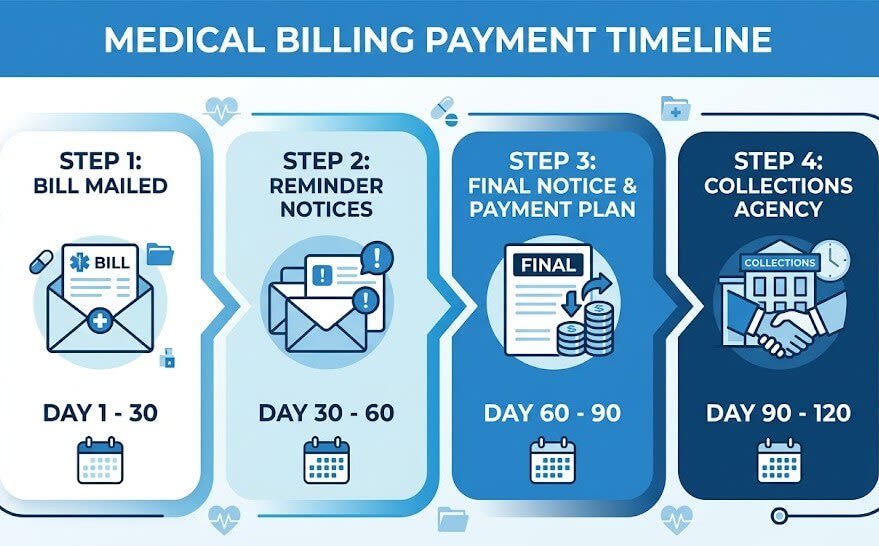
If you can't pay upfront, most facilities will still treat you, especially for anything urgent. What happens next follows a predictable timeline:
Timeline | What Happens |
Day 1–30 | Bill is generated and mailed. No credit impact yet. |
Day 30–60 | Reminder notices are sent. The facility may call to arrange payment. |
Day 60–90 | Final notice. The facility may offer a payment plan or hardship program. |
Day 90–120+ | The account may be sent to a collections agency. It can affect the credit score if the bill exceeds $500. |
Medical Debt and Your Credit Score: 2025–2026 Update
In January 2025, the CFPB finalized a stricter federal rule that would have removed nearly all medical debt from credit reports, regardless of amount. However, in July 2025, a federal court in the Eastern District of Texas vacated this rule, ruling that the CFPB had exceeded its authority under the Fair Credit Reporting Act. As a result, this broader federal protection is not currently in effect.
What this means for uninsured urgent care patients:
A bill under $500 should not appear on your credit report, in accordance with a 2023 policy adopted by the major credit bureaus.
A paid medical bill of any amount should not appear on your credit report.
An unpaid bill over $500 that stays in collections for 12+ months can still be reported, since the stricter 2025 federal rule was struck down.
Some individual states have passed their own laws banning medical debt from credit reports; check your state's specific rules.
Sources: CFPB Regulation V medical debt rule, Court ruling coverage
Hardship and Charity Care Programs
Most large urgent care chains and nearly all hospital-affiliated clinics have financial hardship or charity care programs. These can reduce or even eliminate your bill based on your income. The catch: you have to ask for them. They won't be offered automatically.
What to say at the front desk: Do you have a financial assistance or charity care program I can apply for? Say it before or immediately after your visit.
Real Example: What an Urgent Care Visit Actually Looks Like Without Insurance
Maria, 34, visited an AFC Urgent Care in Dallas with a severe sinus infection. No insurance. The self-pay office visit fee was $145. After diagnosis, the doctor ordered a rapid strep test ($40). Total bill: $185. She couldn't pay in full, asked about a payment plan, and set up $40/month on the spot. No collections. No credit impact. She just had to ask.
How to Negotiate Your Urgent Care Bill (Step by Step)
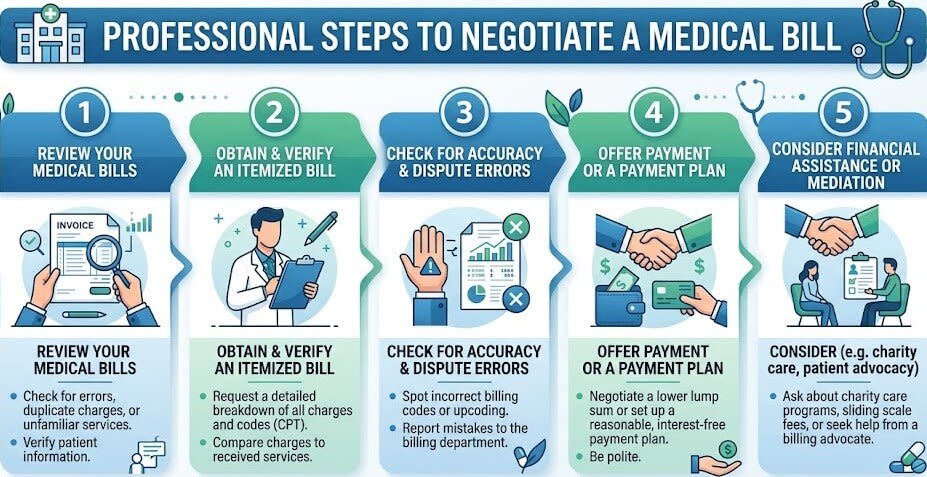
You have more leverage than you think, especially as an uninsured, self-pay patient.
Ask for the self-pay or cash-pay rate first. Before any services begin, say: What is your self-pay rate for this type of visit? Many facilities have a flat discounted rate, often 20–50% below the standard billed rate.
Request an itemized bill. Medical billing errors are common. Ask for a line-by-line breakdown of every charge. Look for duplicate charges, services you didn't receive, or inflated fees for basic supplies.
Accurate medical coding and billing review is how providers catch these same errors before a claim is even sent.
Invoke a financial hardship program. Use exact language: Do you have a charity care or financial assistance application? Many facilities will forgive or significantly reduce bills for patients below 200–250% of the federal poverty level.
Set up a payment plan. If you can't pay in full, ask immediately. Most facilities prefer receiving $30/month indefinitely over sending you to collections. Payment plans are interest-free at most urgent care centers.
Negotiate a lump-sum settlement if the bill is already in collections. Once with a collections agency, you can often settle for 40–60 cents on the dollar. Always get the full settlement agreement in writing before paying.
Your Legal Rights as an Uninsured Patient
The U.S. healthcare billing system is confusing by design, but you do have legal protections.
The Good Faith Estimate (No Surprises Act, 2022)
Under the No Surprises Act (effective January 1, 2022), you have the right to a Good Faith Estimate before scheduled services if you're uninsured or self-pay. This is a written estimate of all expected costs provided before you receive care.
For walk-in urgent care visits, this may not always apply in real-time, but you can request one for any non-emergency follow-up services. If your final bill exceeds the estimate by more than $400, you have the right to dispute it through the federal Patient-Provider Dispute Resolution process. Source: CMS.gov No Surprises Act overview.
Watch Out for the Freestanding ER Trap
Some clinics look like urgent care but are classified as freestanding emergency rooms, and they bill at full ER rates, which can be $1,500–$3,000+ for the same visit that costs $150 at a true urgent care. They're required to post signage, but it's easy to miss.
Always confirm before treatment begins whether the clinic bills as urgent care or as an emergency room. If the answer is ER and your situation isn't life-threatening, you can leave and go elsewhere.
Facility Fees: The Hidden Charge
Hospital-affiliated urgent care centers often charge a facility fee in addition to the doctor's professional fee. This can add $150–$400 to your bill. Independent urgent care clinics typically don't charge facility fees, one more reason to confirm ownership before your visit.
Cheaper Alternatives to Urgent Care If You're Uninsured
Urgent care isn't always the most affordable option. Depending on your condition, these may cost significantly less:
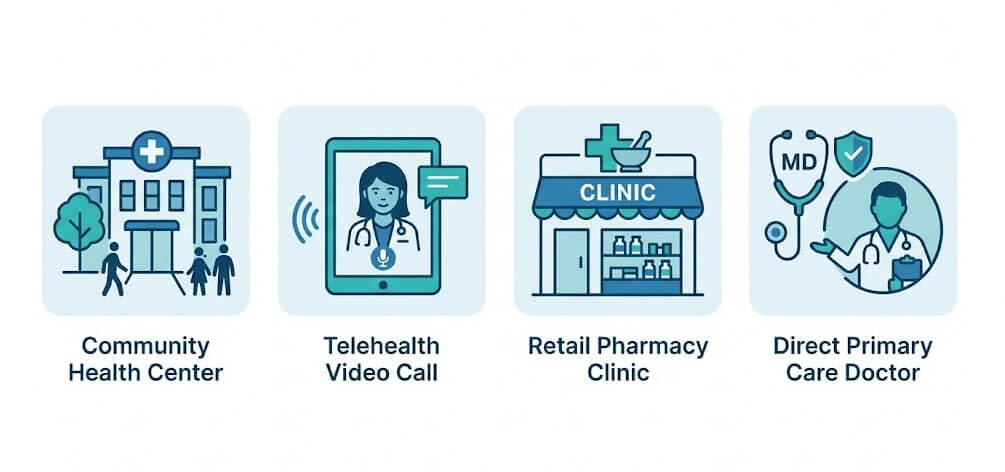
Federally Qualified Health Centers (FQHCs): Community health centers that use a sliding-fee scale tied to your household income and the federal poverty level. Patients at or below the poverty line typically pay a nominal charge, often in the $20–$50 range per visit, with fees stepping up from there for higher incomes but never the full commercial rate. (Source: HRSA / community health center sliding-scale overview)
Telehealth platforms: Virtual visits for non-emergency issues typically run $50–$100 flat with no facility fee. Good for infections, rashes, UTIs, and follow-up questions.
Retail health clinics: CVS MinuteClinic and Walgreens Health offer lower-cost visits ($90–$130) for basic conditions like infections, vaccinations, and wellness checks.
Direct Primary Care (DPC): Monthly membership model ($50–$100/month) giving unlimited primary care visits. Worth it if you expect to need care more than once or twice a year.
Emergency exception: If you're experiencing a true emergency like chest pain, difficulty breathing, severe bleeding, or a suspected stroke, go to the ER immediately. Under EMTALA (42 U.S.C. § 1395dd), hospitals must treat you regardless of insurance status or ability to pay.
Does urgent care bill you later without insurance?
Sometimes, but most urgent care centers ask for payment at the time of service for uninsured patients. Some will bill within 30–60 days, particularly if labs or imaging were involved. Always ask about the billing policy before your visit.
How can I tell if a clinic is urgent care or a freestanding ER?
Freestanding ERs bill at emergency room rates, often 5–10x higher. Ask the billing classification before treatment; leave if it's an ER and you're not facing a true emergency.
Can urgent care refuse to treat me if I can't pay upfront?
For non-emergency visits, yes, private urgent care clinics can decline non-urgent treatment if you can't pay, unlike ERs. Ask about a payment plan or hardship program before you're turned away; most clinics prefer this over losing the visit entirely.
Can I be sued over an unpaid urgent care bill?
It's rare but possible, usually only after the bill has gone to collections and stayed unpaid for a long period. Most providers exhaust reminder notices, payment plans, and hardship options first. Responding early and setting up a payment plan almost always avoids this.
What is the difference between urgent care and a freestanding ER?
Both treat similar conditions, but freestanding ERs bill at emergency room rates, often 5–10x higher than true urgent care. Always ask before treatment: Do you bill as urgent care or emergency room? If the answer is ER, and your situation isn't life-threatening, you can leave and seek care elsewhere.
Conclusion
Does urgent care bill you later without insurance? Most of the time, no, they want payment when you walk out the door. But billing policies vary, hardship programs exist at most major facilities, and your bill is almost always negotiable. The biggest mistake uninsured patients make is assuming the sticker price is final.
Before your next urgent care visit: call ahead, ask about the self-pay rate, and remember that Do you have a financial assistance program? is always a question worth asking. The answer might surprise you.
Related Posts

Ophthalmology Medical Billing Services: Costs, Coding Pitfalls, and How to Choose the Right Partner

Oncology Billing Services: How They Work, What The Cost Is, and How to Choose the Right Partner in 2026

What Are Community Rehabilitation Companies? A Complete US Guide to Types, Funding & Billing
Comments (0)
Comments are disabled for this post.