
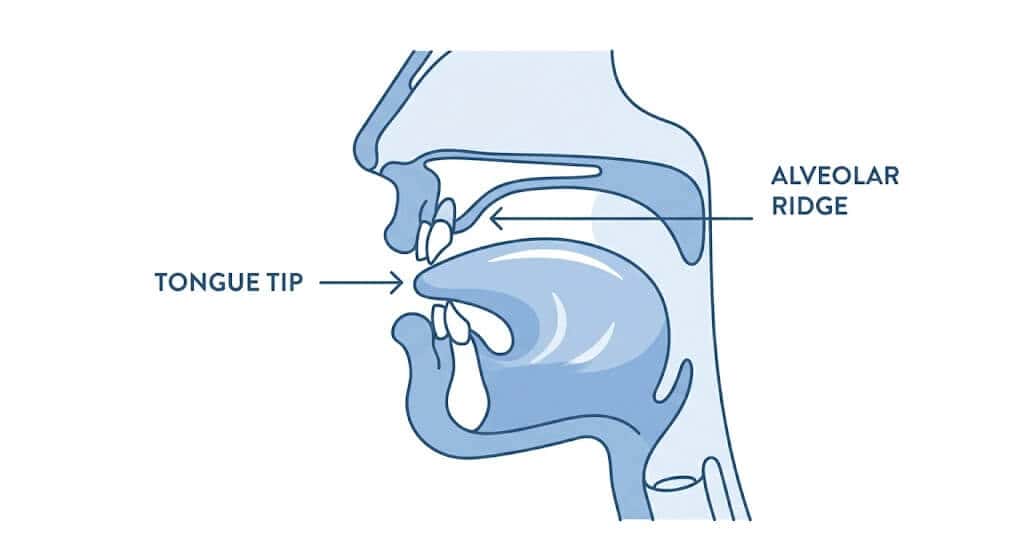
Learn the four types of lisps, what causes them, and how speech therapy can help children and adults improve /s/ and /z/ sounds through targeted treatment and practice.
A lisp changes how the /s/ and /z/ sounds come out of your mouth. It can show up as a soft "th" instead of a crisp /s/, or as a wet, slushy sound that's harder to place. Most advice stops at "see a speech-language pathologist," without explaining what's actually happening with your tongue, what treatment costs, or whether you even need to fix it in the first place.
Speech therapy for lisps starts with knowing your exact lisp type. From there, the right next step depends on your age, your goals, and how much the lisp actually affects you day to day.
What Is a Lisp? (And What's Actually Happening in Your Mouth)
A lisp is a mispronunciation of the /s/ and /z/ sounds. Instead of a crisp, hissing sound, air escapes in the wrong direction or at the wrong spot. Clinically, this falls under "articulation disorder." Most people just call it a lisp. Source: ASHA
Here's what matters: a lisp isn't one single problem. It's a tongue-placement or airflow error, and the exact error determines which type of lisp you have. That distinction shapes everything about treatment.
Why Lisps Happen: Tongue Thrust, Tongue-Tie, and Muscle Patterns
Three mechanisms cause most lisps, and each behaves differently in therapy.
Tongue thrust pushes the tongue forward during swallowing and speech. Over time, this habit trains the tongue to sit too far forward for clean /s/ and /z/ sounds. It often needs oral-motor retraining alongside articulation work.
Tongue-tie restricts how far the tongue can move. A short lingual frenulum limits upward and backward motion, making correct placement physically harder. Severe cases sometimes need a frenectomy before therapy can fully work.
Learned muscle patterns develop from thumb-sucking, prolonged pacifier use, or simply never correcting the sound as a child. These are usually the easiest to retrain, since there's no structural limitation involved.
Knowing your likely cause helps you set realistic expectations before you start.
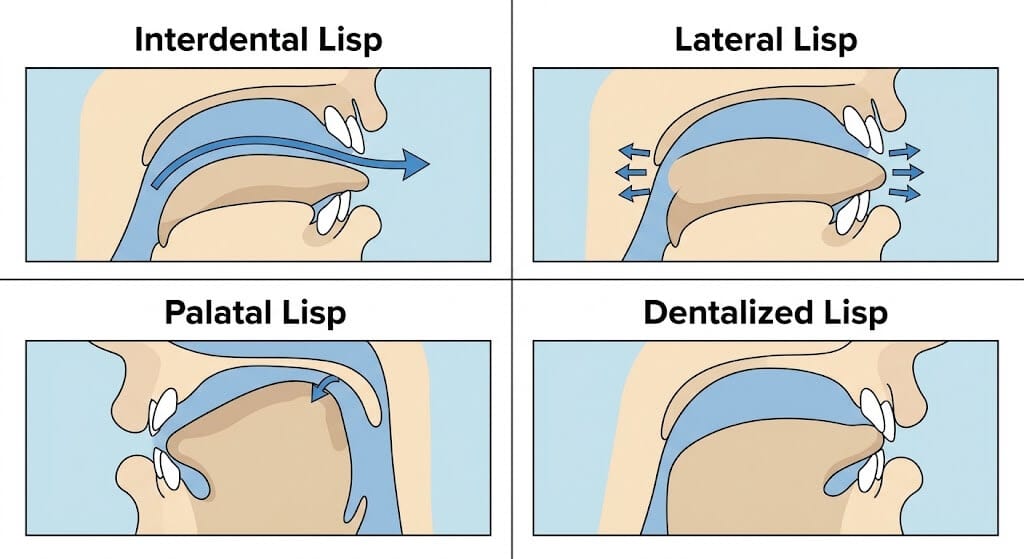
The 4 Types of Lisps
Every lisp falls into one of four categories. Here's how to identify yours before you ever sit down with an SLP.
Interdental (Frontal) Lisp
The tongue pushes between the front teeth. The /s/ sound comes out closer to "th." This is the most common lisp type, and the one most people picture when they hear the word "lisp."
Self-check: Say the word "sun" slowly in a mirror. If your tongue tip shows between your teeth, you likely have an interdental lisp.
Lateral Lisp
Air escapes over the sides of the tongue instead of down the center. This produces a wet, slushy sound that's noticeably different from a standard lisp.
Self-check: Say "zoo" and listen closely. A slushy or "spitty" quality rather than a soft "th" sound points to a lateral lisp. This type rarely resolves without therapy.
Palatal Lisp
The tongue touches the soft palate, farther back in the mouth than it should. This produces a muffled, distorted /s/ sound.
Self-check: This one's harder to self-diagnose by ear alone. If your /s/ sound feels like it's coming from the back of your mouth rather than near your teeth, a palatal lisp is likely. An SLP evaluation confirms it.
Dentalized Lisp
The tongue presses directly against the back of the teeth, rather than just behind them. The sound is close to a correct /s/, but slightly duller and less crisp.
Self-check: This is the subtlest type. Most people only catch it through a professional evaluation or an audio recording played back slowly.
Quick reference:
Lisp type | Sound quality | Tongue position |
Interdental | "th" instead of /s/ | Between the front teeth |
Lateral | Wet or slushy | Air escapes over the sides |
Palatal | Muffled, distorted | Touches the soft palate |
Dentalized | Slightly dull | Against the back of the teeth |
Sources: EBSCO Research Starters, ASHA Journals
Is Speech Therapy for Lisps Necessary or Optional?
Mild interdental lisps in children under five often resolve on their own as oral muscles mature. Speech therapy for lisps becomes more important when a lisp persists past age five, or when it's a lateral or palatal type at any age. Those two types rarely self-correct.
For teens and adults, the decision gets more personal. A lisp that affects job interviews, public speaking, or daily confidence is worth addressing. A lisp that doesn't cause distress is a different story.
Here's the part rarely said out loud: a lisp isn't automatically a flaw. Speech patterns vary, and some people keep a lisp by choice with no negative impact on their life. A lisp has also been unfairly stereotyped in certain communities, sometimes prompting pressure to "fix" speech that was never actually a problem. If your lisp doesn't bother you, you don't owe anyone a correction. Therapy is a tool for people who want it, not an obligation.
How Speech Therapy for Lisps Actually Works
If you decide treatment is right for you, here's what the process looks like.
The Evaluation Process
An SLP evaluation typically runs 45 to 60 minutes. The therapist listens to your speech, watches tongue placement, and checks airflow direction. This confirms your lisp type and rules out contributing factors like tongue-tie or hearing issues.

Core Treatment Techniques
Treatment usually combines a few approaches:
Articulation therapy rebuilds correct sound production step by step, from isolated sounds to full sentences.
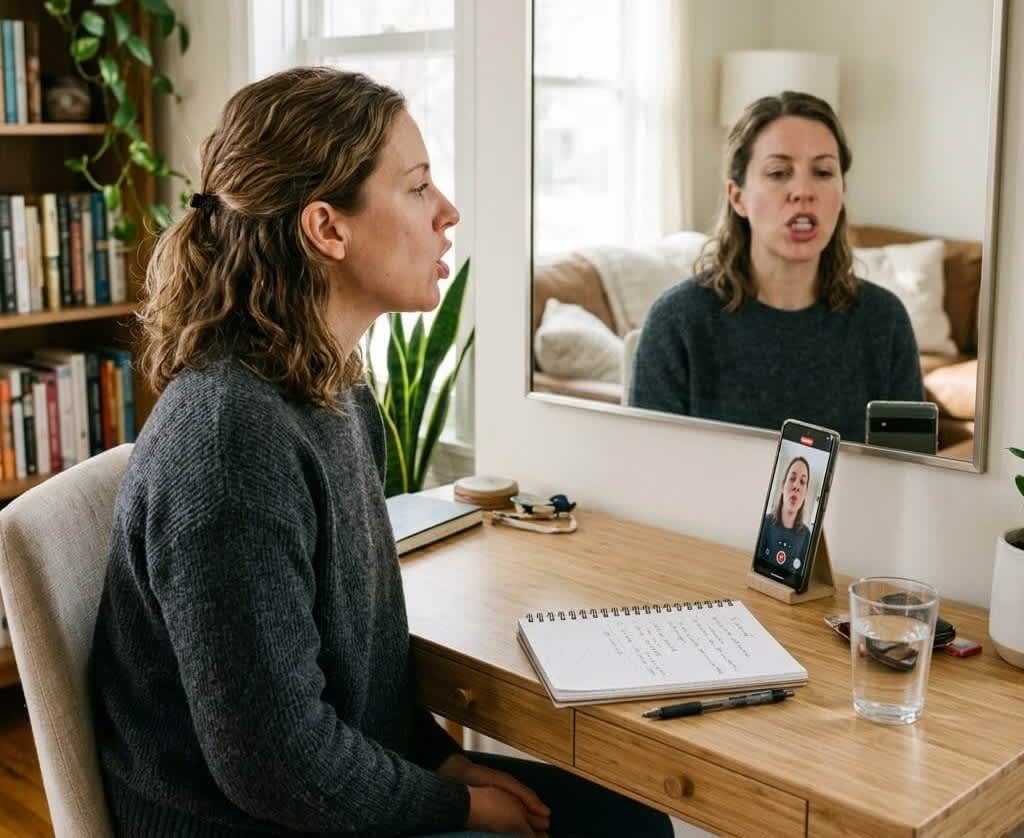
Phonetic placement therapy teaches exact tongue and lip positioning, often using mirrors for visual feedback.
Oral motor exercises build the strength and control needed to hold a new tongue position consistently.
None of these work in isolation. Most SLPs blend all three based on your specific lisp type.
At-Home Practice That Actually Moves the Needle
Weekly sessions alone rarely fix a lisp fast. Daily practice between sessions builds the muscle memory that makes a new sound automatic.
Five to ten minutes a day beats one long session a week. Focus only on the exact sounds your SLP assigned. Practicing random sounds wastes time and can reinforce the wrong pattern.
Speech Therapy for Lisps in Adults vs. Children
Kids and adults approach lisp correction differently, and it's not just about age.
Children often need more play-based motivation and shorter attention spans built into sessions. A therapist might use games, stickers, or storytelling to keep a five-year-old engaged for a full session. Their oral muscles are also still developing, which sometimes makes correction faster, since the motor pattern hasn't fully set. Parents also play a bigger role, reinforcing practice at home between sessions and modeling correct sounds during everyday conversation.
Adults bring stronger motivation but face a more deeply ingrained motor pattern. Decades of saying a sound one way takes longer to unlearn than a habit formed at age six. Self-consciousness can also work against progress, since adults often notice and judge their own mistakes more harshly than kids do.
On the upside, adults are excellent candidates for teletherapy, since they can practice independently, manage their own schedule, and stay consistent without needing a parent to supervise. It's worth noting that no age is "too late" for speech therapy for lisps; the timeline just shifts, and results depend more on consistency than on age alone. Source: EBSCO Research Starters

How Long Does It Take and What Does It Cost?
Timeline: Mild interdental lisps in young children often resolve in three to six months of consistent therapy. Lateral and palatal lisps, and any lisp in an older teen or adult, typically take six months to two years. Progress depends heavily on how consistently you practice at home.
Cost: Private-pay speech therapy sessions generally run $100 to $250 per session in the U.S., though this varies by region and provider. Many health insurance plans cover speech therapy when a doctor's referral documents medical necessity and claims are processed correctly, a common sticking point that's often handled by specialized speech therapy billing services rather than the clinic's front desk. School-based therapy is free for children who qualify through an evaluation, though wait times can be long. Teletherapy platforms often run slightly cheaper than in-person clinics, with subscription-based models becoming common.
Delivery mode | Typical cost | Typical timeline | Best for |
In-person clinic | $100–$250/session | 3 months–2 years | Complex or structural cases (e.g., tongue-tie) |
Teletherapy | $60–$150/session | 3 months–2 years | Adults, flexible schedules |
School-based | Free (with evaluation) | Varies by district | School-age children who qualify |
Self-guided practice | Low or no cost | Slower, less predictable | Mild lisps with strong self-motivation |
In-Person vs. Teletherapy vs. Self-Guided Practice
Each delivery mode fits a different situation, and picking the wrong one can slow your progress.
In-person therapy works best for lateral or palatal lisps, tongue-tie cases, or young children who need hands-on cueing. A therapist in the room can physically guide your tongue or jaw, use tools like tongue depressors, and catch subtle placement errors that are hard to spot on a screen. This mode also tends to work better for kids who need frequent redirection to stay focused.
Teletherapy suits older kids and adults with mild-to-moderate lisps and consistent home practice habits. Sessions happen over video call, so a good camera angle and clear audio matter for the SLP to assess your sounds accurately. It removes commute time, often costs less than in-person visits, and fits easily around work or school schedules. It works less well for lateral lisps, since airflow direction can be hard to judge on video.
Self-guided practice can help mild interdental lisps, especially when paired with one or two paid sessions to confirm correct technique before practicing alone. This route relies on mirror work, recorded audio, and online exercise resources instead of ongoing professional supervision. It costs the least, but it also carries the highest risk of reinforcing bad habits without regular feedback to catch mistakes early.
Can a lisp go away on its own?
Mild interdental lisps sometimes resolve naturally in children under five. Lateral and palatal lisps rarely self-correct at any age.
Can adults fix a lisp without therapy?
Some adults improve mild lisps with focused mirror practice and self-correction. Long-standing or lateral lisps usually need professional guidance to fully correct.
Is a lisp a speech disorder or just a speech pattern?
Clinically, a lisp is classified as an articulation disorder. Whether it needs treatment depends on how much it affects your communication and confidence.
How do I know what type of lisp I have?
Listen for a "th" sound (interdental), a wet or slushy sound (lateral), or muffled placement (palatal). An SLP evaluation gives a definitive answer.
Does insurance cover speech therapy for a lisp?
Many plans cover it with a doctor's referral documenting medical necessity. Coverage details vary widely, so checking with your provider first saves confusion later.
Related Posts

Pain Management Billing Services: A Practical Guide to Codes, Compliance, and Choosing a Partner

Dental Billing Remote Services: What They Really Cost and How to Choose the Right Provider

Medical Billing for Small Practices: A Complete Guide to Costs, Options, and Getting Paid Faster
Comments (0)
Comments are disabled for this post.