
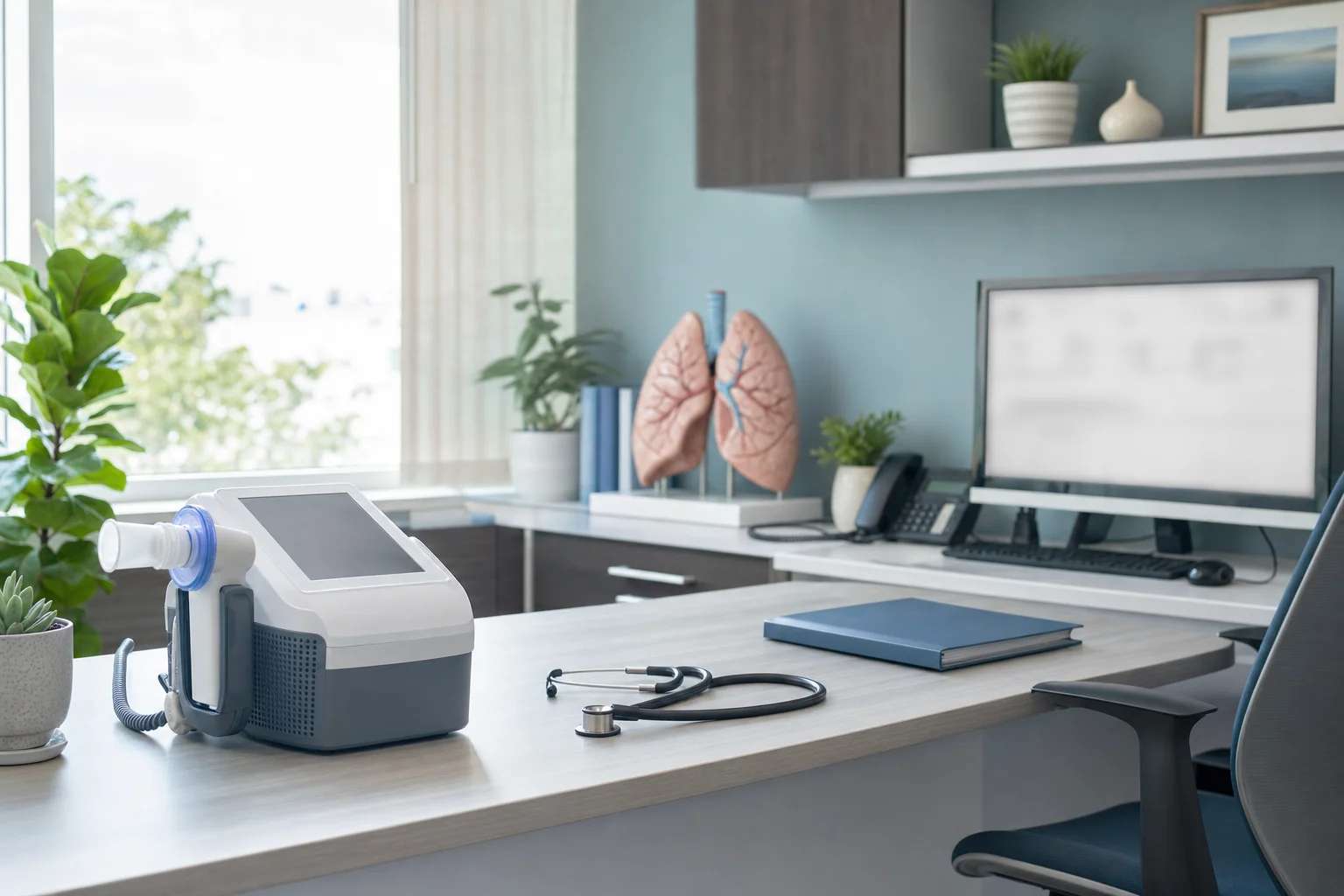
Pulmonology billing covers three kinds of work that pay under different rules: office visits, diagnostic tests such as pulmonary function tests (PFTs) and sleep studies, and procedures such as bronchoscopy. Most lost revenue comes from a short list of mistakes. Spirometry gets billed next to a code that already includes it. An interpretation report is missing. A diagnosis code does not prove medical necessity. Critical care time does not add up.
To get paid cleanly, a pulmonology practice needs the right CPT code for each test, the right modifier for where the test was done, and notes that tie every service to a covered diagnosis. This guide walks through the codes, the bundling rules payers apply most, and how to fix the denials that keep coming back.
Key takeaways
94060 already includes spirometry (94010) and the bronchodilator treatment. Never bill them together.
Diagnostic bronchoscopy (31622) is included in every surgical bronchoscopy code.
Use modifier 26 when you only read the test, for example a PFT done in a hospital lab.
Ventilator management and pulse oximetry are bundled into critical care for Medicare.
Most PFT and sleep denials trace back to diagnosis specificity or missing prior authorization.
What makes pulmonology billing different
A pulmonologist often works in four settings in the same week. Each one changes which codes and modifiers apply, and who bills for what.
Office: E/M visits plus in-office PFTs, billed globally if you own the equipment.
Hospital outpatient lab: you bill only the professional read with modifier 26. The hospital bills the technical part.
Inpatient and ICU: hospital visits, critical care time and bedside procedures.
Sleep lab or home testing: polysomnography or home sleep tests, often split into technical and professional parts.
Add chronic conditions like COPD and asthma, which bring frequency limits and prior auth rules, and you get a specialty where small coding habits have a large effect on cash flow.
Pulmonary function test (PFT) CPT codes
PFTs are where most pulmonology billing errors start. The codes overlap, and several are add-ons that only pay with a base code.
CPT code | What it covers | Billing note |
|---|---|---|
94010 | Spirometry | Do not bill with 94060 or 94070 |
94060 | Spirometry before and after bronchodilator | Includes 94010 and nebulizer 94640 |
94726 | Lung volumes by plethysmography | Pick one lung volume method per session |
94727 | Lung volumes by gas dilution or washout | Not with 94726 for the same test |
94729 | Diffusing capacity (DLCO) | Add-on: needs a base PFT code |
94070 | Bronchospasm provocation (methacholine) | Bill the drug separately with J7674 |
94618 | Pulmonary stress test, such as a 6-minute walk | Document oxygen readings during the walk |
94621 | Cardiopulmonary exercise test (CPET) | Includes the oximetry done during the test |
95012 | Exhaled nitric oxide (FeNO) | Coverage varies by payer; check policy first |
PFT rules behind most denials
Bundled spirometry: 94010 billed with 94060 is a classic NCCI edit. Bill 94060 alone.
Bronchodilator billed twice: the nebulizer treatment (94640) used during 94060 is part of the test.
Pulse oximetry: 94760 and 94761 are bundled for Medicare when another paid service is on the same claim.
Orphan add-ons: 94729 alone will deny. It must sit on the same claim as its base code.
Missing interpretation: a global or 26 claim needs a signed physician read in the chart.
Tip: Build your PFT charge sheet around test panels, not single codes. If the panel says "full PFT," the sheet should drop 94060, 94726 and 94729 together, and block 94010 from appearing on the same date.
Bronchoscopy coding
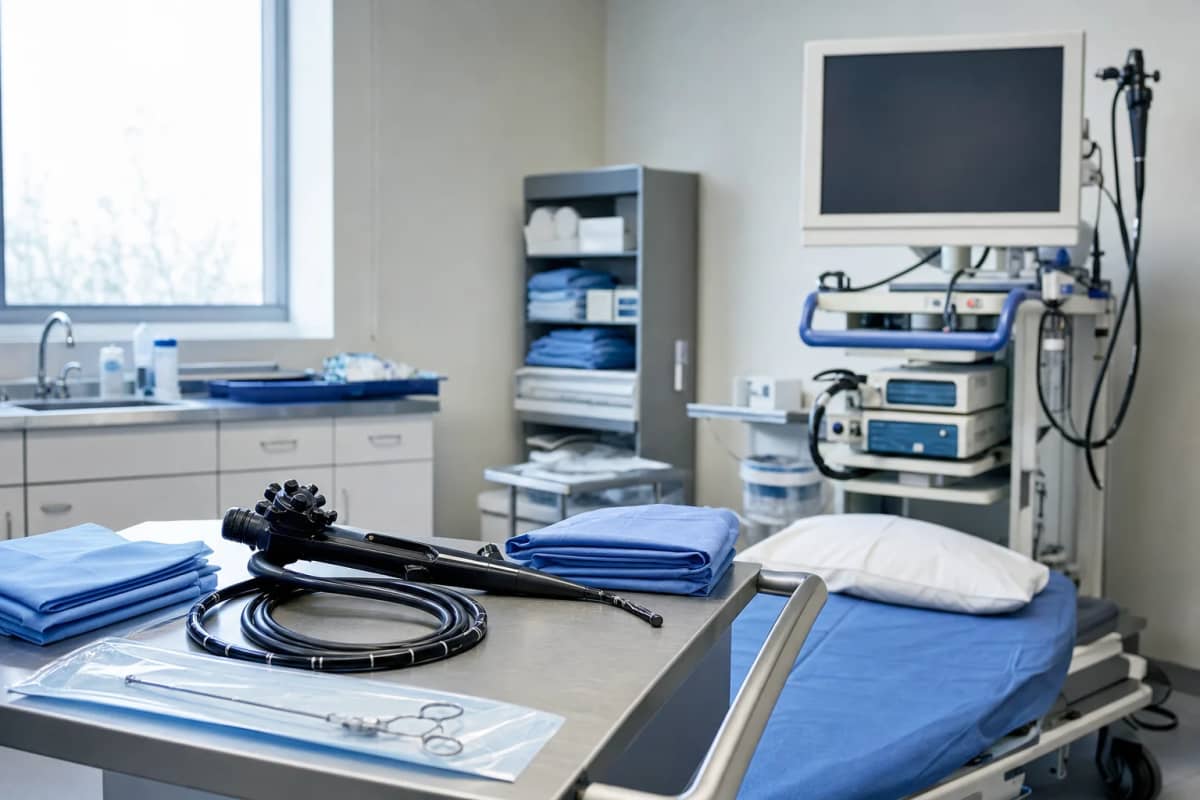
Bronchoscopy codes are built in layers. The diagnostic scope (31622) is the base, and every surgical bronchoscopy already includes it. Billing 31622 next to a biopsy code is a fast way to trigger a bundling denial.
CPT code | What it covers |
|---|---|
31622 | Diagnostic bronchoscopy, with or without cell washing |
31623 | With brushing or protected brushings |
31624 | With bronchoalveolar lavage (BAL) |
31625 | With bronchial or endobronchial biopsy |
31628 | Transbronchial lung biopsy, single lobe |
31632 | Add-on: transbronchial biopsy, each additional lobe |
31652 / 31653 | EBUS-guided needle sampling, 1 to 2 or 3+ nodal stations |
31654 | Add-on: radial EBUS for peripheral lesions |
31627 | Add-on: computer-assisted navigation |
Sedation and multiple procedures
When the same physician who does the bronchoscopy also gives moderate sedation, report 99152 for the first 15 minutes and 99153 for each extra 15 minutes, for patients 5 or older. Record start and stop times and the presence of an independent trained observer. If anesthesia staff handle sedation, you do not bill these codes.
Several bronchoscopic services in one session are common, such as BAL and transbronchial biopsy. Commercial payers may want modifier 51 on the secondary codes. Only use 59 or an X modifier when the services were truly distinct, such as different lobes or a different lesion, and the note says so.
Sleep medicine and critical care overlap

Sleep studies
Many pulmonologists also read sleep studies. In-lab polysomnography uses 95810, and a study with CPAP titration uses 95811. Home sleep tests use 95806 for commercial payers, and Medicare also recognizes G0398, G0399 and G0400. Many commercial plans require prior auth for in-lab studies and expect a home test first unless the notes show why it is not suitable. Our guide to home sleep test claims covers those rules in detail.
Critical care
Critical care uses 99291 for the first 30 to 74 minutes and 99292 for each added 30 minutes. Medicare applies a stricter rule for 99292: the first unit is only billable once total time reaches 104 minutes. Time must be documented as a total, and time spent on separately billed procedures must be left out.
Bundled into critical care (Medicare): ventilator management (94002 to 94004), pulse oximetry, chest X-ray interpretation, gastric intubation and routine blood draws.
Billed separately: endotracheal intubation (31500), central lines (36556), and bronchoscopy, with that time removed from the critical care total.
Split or shared visits: when a physician and an NPP share critical care, add modifier FS and bill under whoever provided the substantive portion.
Same-day E/M: Medicare allows an earlier E/M plus critical care with modifier 25 when the patient was not critically ill at the first visit. The notes must show that change.
Common denial: 99292 billed to Medicare with 80 minutes of documented time. It follows the CPT threshold but not the CMS one, so the unit is denied. Set a payer-specific rule in your billing system.
Pulmonology billing modifiers
Modifier | When to use it |
|---|---|
26 | You interpret a test done on someone else's equipment |
TC | You bill only the technical part of a test you own |
25 | Separate, significant E/M on the same day as a procedure or test |
59 / XS / XU | Distinct service that would otherwise bundle |
52 | Reduced service, such as an incomplete PFT |
76 | Same test repeated the same day by the same physician |
FS | Split or shared visit between physician and NPP |
GA | Signed ABN on file for a Medicare service likely to be denied |
Modifier 25 deserves extra care. A visit where the physician reviews new PFT results and changes the COPD plan can support it. A visit that only orders the test usually cannot. Strong medical coding habits catch this before the claim goes out.
Common pulmonology denials and how to fix them

Denial code | Usual cause | Fix |
|---|---|---|
CO-97 (bundled) | 94010 with 94060, or 31622 with a surgical scope | Remove the included code; add a modifier only if truly distinct |
CO-50 (medical necessity) | Vague diagnosis, such as unspecified cough | Code to full specificity and match the payer's policy |
CO-197 (no authorization) | Sleep study or bronchoscopy without prior auth | Verify auth rules at scheduling, not after the test |
CO-151 (frequency) | Repeat PFTs beyond the payer's limit | Document a change in condition or treatment |
CO-4 (modifier) | Missing 26 on a hospital-based read | Match modifier to the place of service |
CO-16 (missing info) | No interpretation or ordering provider | Attach the signed report and fix the claim fields |
Track denials by code and by payer each month. If one reason shows up again and again, fix the charge sheet or front desk step that causes it. Reworking the same denial every week costs more than fixing the source. A focused denial management process makes those patterns easy to see.
Pulmonology billing requirements: a documentation checklist
Payers rarely deny a pulmonology claim because the code is wrong. They deny it because the chart does not back it up. Use this checklist before you release a test or procedure claim.
An order from the treating provider with the reason for the test.
A diagnosis coded to full specificity, such as COPD with acute exacerbation (J44.1) instead of unspecified COPD (J44.9).
For asthma, the severity and control status, which drive the right J45 code.
A signed physician interpretation for every PFT, sleep study or imaging read you bill.
Test quality notes, such as whether spirometry met acceptability standards.
For bronchoscopy, the lobes or nodal stations sampled and the method used.
For critical care, total time, the organ failure treated, and time excluded for procedures.
Eligibility and prior auth confirmed before the appointment.
Tip: Check the supervision level CMS assigns to each diagnostic test code. If the required physician supervision was not present in the office, the test may not be payable no matter how clean the claim is.
Pulmonology billing cost: in-house vs outsourced
There is no single price for pulmonology billing. Cost depends on claim volume, payer mix, how much hospital and ICU work you do, and whether coding is included. These are the common setups.
Option | How you pay | Best fit |
|---|---|---|
In-house team | Salaries, benefits, software, training | Large groups with steady volume and coding staff |
Percentage of collections | A share of what is collected | Practices that want the vendor paid on results |
Flat fee per claim or month | Fixed rate regardless of collections | Predictable, high-volume office practices |
Hybrid | In-house front desk, outsourced coding and AR | Practices with a good team but a backlog |
When you compare vendors, ask how they handle 26 and TC splits, Medicare critical care time, and PFT bundling edits. Ask for their clean claim and denial rates and how they report them each month. A vendor who cannot answer those questions in pulmonology terms will learn on your revenue.
Where to start if claims are slipping
Pull 90 days of denials and sort them by reason code. If bundling and medical necessity lead the list, the fix is in coding and the charge sheet. If authorization and eligibility lead, the fix is at the front desk. A medical billing audit can show you which one it is with real numbers from your own claims.
MI MedCare works with practices in 40+ specialties, with 20+ certified billers and coders and a 98% clean claim rate. You can see how we handle PFT, bronchoscopy and critical care claims on our pulmonology billing page.
If you want a second set of eyes on your pulmonology claims, contact us to request a free consultation. We will look at where your denials come from and tell you plainly what we would fix first.
Frequently asked questions
What CPT code is used for pulmonary function tests?
There is no single PFT code. Spirometry is 94010, spirometry before and after a bronchodilator is 94060, lung volumes are 94726 or 94727, and diffusing capacity is the add-on 94729. Bill the codes that match the tests actually performed and do not combine codes that include each other.
Can 94010 and 94060 be billed together?
No. 94060 already includes the spirometry in 94010, so billing both on the same date triggers a bundling denial. Bill 94060 alone when a bronchodilator study was done.
When should a pulmonologist use modifier 26?
Use modifier 26 when you interpret a test performed on equipment you do not own, such as a PFT or sleep study done in a hospital lab. The facility bills the technical component, and you bill the professional read with a signed interpretation in the chart.
What are the most common pulmonology billing denials?
The most common are bundling denials (such as 94010 with 94060), medical necessity denials from unspecific diagnosis codes, missing prior authorization for sleep studies and bronchoscopy, and frequency limits on repeat PFTs. Most can be prevented with charge sheet edits and checks before the appointment.
How much do pulmonology billing services cost?
It depends on your claim volume, payer mix and the mix of office, hospital and ICU work. Vendors usually charge a percentage of collections, a flat fee per claim or month, or a hybrid. Ask any vendor to explain exactly what is included, especially coding and denial follow-up.
Related Posts



Comments (0)
Comments are disabled for this post.