

Not sure how many HST claims your practice is losing to denials each year?Talk to a MI MedCare specialist about a free billing audit tailored to sleep medicine.
If your sleep center is watching home sleep test claims bounce back week after week, you're not imagining it. Sleep medicine billing has more moving parts than almost any other diagnostic specialty, and a single missed modifier or an unverified prior authorization can turn a $250 claim into a write-off.
This guide walks through exactly where HST claims break down, how to fix the recurring problems, and how to estimate what those denials are actually costing your practice every year.
Why Home Sleep Test (HST) Billing Is So Error-Prone
Sleep medicine sits at an awkward intersection of coding rules. A single home sleep test can involve several components: device rental, a technical recording component, physician interpretation, a facility-setting question, and a payer-specific authorization requirement. All of this has to line up before the claim even reaches a payer's desk.
Add to that the fact that Medicare and commercial payers use different code sets for the same service, and it's easy to see why sleep study denial rates run higher than routine office visit denials. Most practices don't realize how much this adds up until they actually total their denied claims for a quarter.
Almost every HST denial traces back to one of five root causes. Once your billing team knows what to check before submission, denial rates drop fast.
HST CPT & HCPCS Codes You Need to Know
Before fixing denials, your team needs to be fluent in the exact codes payers expect because using the wrong code set is one of the most common (and completely avoidable) reasons claims get rejected outright.
CPT Codes for Home Sleep Testing (95800, 95801, 95806)
These three codes cover unattended home sleep studies, and the difference between them comes down to how many physiological channels the device records:
95800: Sleep study, unattended, recording heart rate, oxygen saturation, respiratory airflow, and respiratory effort.
95801: Similar to 95800, but without the airflow measurement.
95806: Sleep study, unattended, with respiratory and airflow monitoring plus additional parameters.
Commercial payers generally accept these CPT codes for home sleep apnea testing.
Medicare HCPCS Codes (G0398, G0399, G0400)
Medicare doesn't use the CPT codes above for home sleep testing. Instead, it requires HCPCS Level II codes based on the number of channels the device monitors:
G0398: HST with a type II device (minimum 7 channels).
G0399: HST with a type III device (minimum 4 channels) — this is the most commonly billed code in practice.
G0400: HST with a type IV device (minimum 3 channels).
Submitting a CPT code like 95800 or 95806 to Medicare instead of the correct HCPCS code results in an automatic denial. This single mix-up is one of the most frequent and easiest to prevent billing errors in sleep medicine. Source: American Academy of Sleep Medicine
The Modifier 26 vs TC Split Where Most Practices Get It Wrong
This is where a lot of sleep centers lose money without realizing it. Home sleep testing has two separate components that get billed differently:
Technical Component (TC): Covers the equipment, the device setup, and the data recording itself.
Professional Component (26): Covers the physician's interpretation and written report.
If your sleep center provides the device but an outside physician interprets the results, you bill TC only and the interpreting physician bills 26 separately. If your practice handles both the equipment and the interpretation, you can bill globally without any modifier rather than splitting it.
The mistake that shows up constantly: billing G0399 with modifier 26 attached when it should be billed as a global code, or splitting a claim between two providers without confirming who actually performed which piece. Payers catch this quickly, and the claim gets denied for a code-modifier mismatch rather than paid and later audited.
Before you submit, confirm in writing (not just verbally) who did the technical setup and who did the interpretation, and match your modifier to that reality.
Payer-Specific Rules That Trigger Denials
Generic billing advice tends to stop here. But denial patterns look different depending on who you're billing, and treating every payer the same is where a lot of preventable denials come from.
Medicare MAC Differences
Medicare Administrative Contractors (MACs) like Novitas, Palmetto GBA, and NGS Medicare each maintain their own Local Coverage Determinations (LCDs) for sleep studies. These LCDs can differ on:
Which ICD-10 diagnosis codes support medical necessity in that jurisdiction
Documentation requirements for repeat testing
Whether a face-to-face evaluation must precede the HST order
Before you assume a claim will be paid because it worked with one MAC, check the LCD that applies to your practice's region. What's accepted in one jurisdiction can be denied in another for the same clinical scenario. Source: CMS Medicare Coverage Database
Commercial Payer Rules
Payer | Prior Authorization Required | Common Denial Trigger |
UnitedHealthcare | Yes, for most HST orders | Missing clinical notes supporting OSA symptoms |
Aetna | Yes, varies by plan | Authorization obtained for wrong CPT code |
Cigna | Case-by-case | Device type not matching authorized code |
Repeat Testing & Frequency Limits (The 72-Hour Rule)
When a home sleep test comes back inconclusive, often due to insufficient recording time or equipment failure, practices frequently rebill without checking payer frequency limits first.
Many payers require a minimum waiting period, commonly around 72 hours, before a repeat HST is billable for the same diagnosis. Others require documentation explaining specifically why the first test failed (technical malfunction versus insufficient data versus patient non-compliance), since these are treated differently for coverage purposes.
Before scheduling a repeat test, confirm the payer's frequency policy and make sure the ordering physician's note explicitly states why the first result was unusable. Vague notes like test incomplete are a common reason resubmissions get denied a second time.
Same-Day E/M Visit + HST Billing (Modifier 25)
It's common for a physician to evaluate a patient for suspected sleep apnea and order the home sleep test during that same visit. When that happens, you're billing an E/M code along with the sleep study order. Add modifier 25 to the E/M code. It shows the visit was a separate, significant service, not just part of ordering the test.
Skip the modifier, and payers frequently bundle the E/M visit into the testing charge, cutting your reimbursement for work that was clearly documented as separate. The documentation must support this too. A note that just says ordered HST isn't enough. It needs to capture the actual clinical evaluation, or the claim won't hold up if questioned.
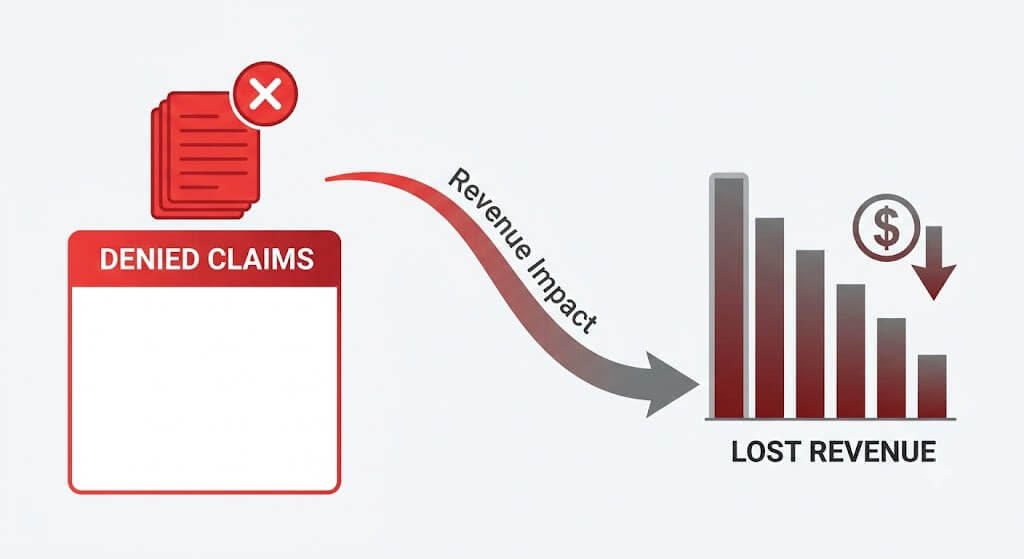
How Much Revenue Are You Actually Losing? (HST Denial Calculator)
Most practices underestimate this because denied claims get resubmitted, written off, or forgotten in a pile rather than tracked as a running total. Here's a simple way to see the real number.
Formula: Average HST claim value × Number of denied claims per month × 12
Example: A sleep center billing G0399 at an average reimbursement of $220 per claim, with 8 denied HST claims per month that never get successfully appealed, loses: $220 × 8 × 12 = $21,120 per year
That's before accounting for the staff time spent chasing each denial, which typically adds another several hours of administrative cost per claim. Run this math with your own numbers: your average claim value and your monthly denial count. The real annual impact is usually higher than expected.
Pre-Submission Checklist to Prevent HST Denials
Build this into your workflow before any HST claim goes out the door:
Confirm payer type (Medicare vs. commercial) and use the correct code set (HCPCS vs. CPT)
Verify prior authorization matches the exact CPT/HCPCS code and device type being billed
Confirm whether the claim should be split (TC/26) or billed globally, based on who performed which component
Match the ICD-10 diagnosis code to the payer's specific coverage policy
Check frequency limits before billing a repeat test, and document the reason for repeat testing clearly
Add modifier 25 to same-day E/M visits when clinically supported
Review documentation for medical necessity language before submission, not after a denial
Running through this list consistently catches the majority of preventable HST denials before they ever reach a payer.
How MI MedCare Helps Sleep Medicine Practices Recover Lost Revenue
Sleep medicine billing requires certified coders. They need to know the difference between a G0399 global claim and a split TC/26 submission. They also need to check payer-specific rules before a claim goes out, not after it comes back denied.
MI MedCare's team maintains a 98% first-pass clean claim rate across specialty billing, including sleep medicine, backed by dedicated eligibility verification and denial management support.
Does Medicare cover home sleep apnea testing?
Yes, Medicare covers home sleep apnea testing when medical necessity is documented, and the correct HCPCS code (G0398, G0399, or G0400) is billed based on the device type used.
What's the difference between HST and in-lab polysomnography billing?
HST billing uses HCPCS codes for Medicare and covers respiratory-focused channels only. In-lab polysomnography (billed under codes like 95810) is attended and records more parameters, including sleep staging. It also involves higher reimbursement due to the added complexity.
How do I bill CPAP compliance monitoring after a positive HST?
CPAP compliance monitoring is billed separately from the original sleep study, using codes specific to remote adherence tracking, and requires documentation showing ongoing patient usage data over a defined monitoring period.
What ICD-10 code supports HST medical necessity?
G47.33 (obstructive sleep apnea) is the most commonly used diagnosis code. But accepted codes can vary by Medicare MAC jurisdiction and by commercial payer policy. It's worth confirming against the specific payer's coverage policy before submission.
Why do sleep study claims get denied for medical necessity even with a valid diagnosis?
This usually happens when the clinical documentation doesn't connect the patient's symptoms and exam findings to the diagnosis code billed. The diagnosis code alone isn't enough. The chart note also needs a supporting narrative.
Related Posts


Comments (0)
Comments are disabled for this post.