

Anesthesia medical billing services help anesthesiologists and CRNA groups improve coding accuracy, reduce denials, and maximize reimbursement through proper time tracking, modifiers, and claims management.
Anesthesia medical billing services help hospitals, anesthesiologists, and CRNA groups get paid accurately for time-based care. Unlike most medical specialties, anesthesia billing depends on base units, time units, and modifiers instead of a flat fee per procedure.
That difference trips up even experienced billing teams. Small errors in documentation or modifier use can lead to denied claims and lost revenue, which is why so many practices choose to work with specialists who understand anesthesia billing well.
What Are Anesthesia Medical Billing Services?
Anesthesia medical billing services manage the coding, claims submission, and reimbursement process for anesthesia care. They cover everything from charge capture to denial appeals. The goal is simple: get every dollar a provider earned, without delays or compliance risk.
These services matter most for hospital-employed anesthesiologists, independent anesthesia groups, CRNA practices, and ambulatory surgery centers. Each setting has its own billing quirks, which we'll cover later in this guide.
Anesthesia billing differs from general medical billing because of its payment structure. Most specialties bill a flat rate per procedure. Anesthesia bills by time, complexity, and provider involvement. That single distinction drives almost every challenge in anesthesia revenue cycle management. Practices looking for dedicated support can explore specialized anesthesia billing services built specifically around these workflows.
Why Anesthesia Billing Is More Complex Than Standard Billing
Anesthesia billing involves several moving parts working together at once. Base units, time units, and modifiers each affect the final payment, and getting any one of them wrong can change the outcome of a claim.
Base Units vs. Time Units
Every anesthesia procedure carries an ASA-assigned base unit value. This number reflects the complexity of the procedure itself, independent of how long it takes. A hip replacement carries a higher base unit value than a routine endoscopy, for example.
Time units work differently. They're calculated from the anesthesia record, starting when the anesthesiologist begins preparing the patient and ending when they're no longer under continuous care. Most payers convert every 15 minutes of documented time into one time unit, though conversion rules vary by payer.
Both numbers matter. Base units without accurate time tracking undervalue a claim. Time units without correct base values do the same. Getting both right is the foundation of accurate anesthesia billing. Source: CMS Anesthesiologists Center
The Anesthesia Reimbursement Formula
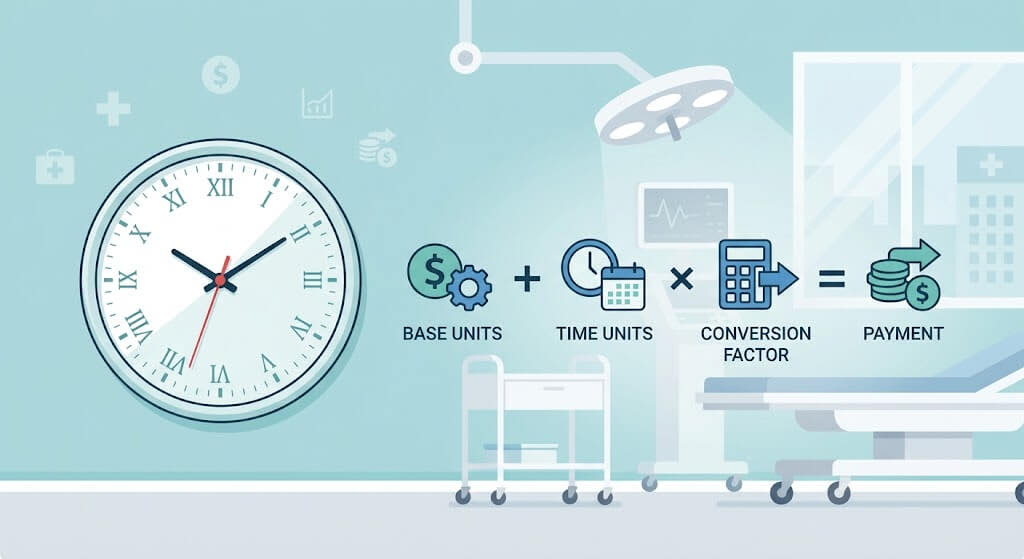
Here's the formula anesthesia billing services use to calculate payment:
(Base Units + Time Units + Modifying Units) × Conversion Factor = Reimbursement
Let's walk through an example. Say a patient undergoes a 90-minute procedure with a base unit value of 5.
Base units: 5
Time units: 90 minutes ÷ 15 = 6 time units
Modifying units: 0 (no complicating factors)
Total units: 11
Conversion factor: $22 per unit (this varies by payer and locality)
Total reimbursement: 11 × $22 = $242
Change any single input, and the payment shifts. A five-minute documentation gap can cost an entire time unit. A missing modifier can trigger a full denial. This is why anesthesia coding services exist as a distinct specialty within medical billing.
Modifiers That Affect Payment
Modifiers tell the payer who performed the anesthesia and under what circumstances. Using the wrong one is one of the most common reasons anesthesia claims get denied or underpaid.
Modifier | Meaning | Payment Impact |
AA | Anesthesia personally performed by an anesthesiologist | Full payment rate |
QK | Medical direction of 2–4 concurrent cases | Reduced payment, split with QX |
QX | CRNA service with medical direction by physician | Reduced payment, split with QK |
QY | Medical direction of one CRNA by one anesthesiologist | Reduced payment, split with QX |
QZ | CRNA service without medical direction | Full payment rate for CRNA |
AD | Medical supervision, more than 4 concurrent cases | Lowest payment tier |
GC | Resident involved under teaching physician | Requires teaching attestation |
Physical status modifiers (P1 through P6) also apply. They reflect patient health at the time of anesthesia and can add modifying units for higher-risk cases. A P4 patient, for instance, may justify additional units that a P1 patient wouldn't.
Anesthesia CPT Codes You Need to Know
Anesthesia CPT codes fall primarily within the 00100–01999 range, organized by anatomical site and procedure type. This is different from the 99100–99140 series, which covers qualifying circumstances like extreme age or emergency conditions, not the base anesthesia service itself.
Code Range | Category |
00100–00222 | Head |
00300–00352 | Neck |
00400–00474 | Thorax |
00500–00580 | Intrathoracic |
00600–00670 | Spine and spinal cord |
00700–00797 | Upper abdomen |
00800–00882 | Lower abdomen |
00902–00952 | Perineum |
01112–01173 | Pelvis |
01200–01274 | Upper leg |
01320–01444 | Knee and popliteal area |
01462–01522 | Lower leg |
01610–01682 | Shoulder and axilla |
01710–01782 | Elbow and forearm |
01810–01860 | Wrist, hand, fingers |
01916–01936 | Radiological procedures |
01951–01999 | Burn excision, obstetric, other |
Add-on codes 99100–99140 apply on top of the primary anesthesia code when specific risk factors are present, such as patient age under one year or over 70, or emergency circumstances. They add units but never replace the base anesthesia code. Source: AAPC.com
Common Anesthesia Billing Challenges and Denial Triggers
Most anesthesia claim denials trace back to a small set of recurring issues. Knowing what they are makes them much easier to prevent.
Documentation Gaps
Start and stop times drive time-unit calculations. If the anesthesia record and the surgical report disagree on total time, payers flag the claim. Even small inconsistencies between documentation sources create denial risk.
Modifier and Concurrency Errors
Concurrency rules limit how many cases an anesthesiologist can medically direct simultaneously and still qualify for the QK modifier. Exceed that limit without adjusting the modifier, and the claim gets rejected. This is one of the most frequent errors in anesthesia billing services today.
Payer-Specific Rule Variability
Medicare, Medicaid, and commercial payers each interpret medical direction, supervision, and time reporting differently. A claim built correctly for Medicare may fail commercial payer edits. Anesthesia billing teams need payer-specific playbooks, not a one-size-fits-all process.
Denial rates for anesthesia claims without specialized billing oversight often run higher than other specialties, largely due to these three factors combined. Practices that invest in dedicated anesthesia coding services typically see denial rates drop significantly within the first few billing cycles.
How to Evaluate an Anesthesia Billing Company
Not all anesthesia billing companies offer the same depth of service. Use this checklist when vetting a potential partner.
Credentialing and Payer Enrollment Support
Ask how the vendor handles CAQH attestation and re-credentialing. Payer enrollment delays can stall revenue for months if credentialing isn't proactively managed.
Denial Management Turnaround Time
Find out how quickly appeals get filed after a denial. Anesthesia billing outsourcing only pays off if denials are worked fast enough to beat timely filing limits, which are often as short as 90 days depending on the payer.
Reporting and Transparency
You should receive regular, detailed reports on collections, denial trends, and days in accounts receivable. If a vendor can't show you this data clearly, that's a warning sign.
Specialty-Specific Experience
Ask directly whether the team has experience billing for your exact setting. CRNA billing services differ from anesthesiologist billing, which differs again from ASC-based anesthesia billing. General medical billing experience isn't the same as anesthesia expertise.

Compliance Considerations in Anesthesia Billing
Billing accuracy isn't the only concern for anesthesia practices. Several regulations directly affect how claims should be documented, disputed, and reported, and staying compliant reduces audit exposure.
No Surprises Act Impact on Anesthesia Claims
The No Surprises Act affects how out-of-network anesthesia claims are billed and disputed, particularly for cases at in-network facilities with out-of-network anesthesia providers. Billing teams need workflows built around good-faith estimates and the independent dispute resolution process. Source: CMS.gov
MIPS and QPP Reporting for Anesthesia Groups
Anesthesia groups participating in Medicare's Quality Payment Program must report on measures relevant to their specialty. Billing and quality reporting need to stay aligned, since payment adjustments under MIPS can affect future reimbursement rates. Source: QPP.CMS.gov
OIG Audit Focus Areas
The Office of Inspector General has historically scrutinized anesthesia claims for concurrency violations and medical direction documentation. Practices should keep provider attestations, time records, and op-notes organized and audit-ready at all times. Source: OIG.HHS.gov
Anesthesia Billing by Practice Setting
Billing rules shift depending on where and how anesthesia is delivered. Here's how the process differs across the most common practice settings.
Hospital-Employed Anesthesiologists
Hospital-based anesthesiologists often bill under complex medical direction arrangements involving CRNAs. Getting the QK, QX, and QY modifier combinations right is essential here.
Independent CRNA Groups
CRNA-only groups typically bill under the QZ modifier when working without physician direction. Billing accuracy depends heavily on documenting the scope of independent practice correctly for each state.
Ambulatory Surgery Centers
ASC-based anesthesia billing often involves higher claim volume with shorter, more standardized procedures. Efficient charge capture matters more here than in complex hospital cases.
Office-Based Anesthesia
Dental and GI/endoscopy anesthesia billing frequently involves different payer rules than hospital-based care, including separate documentation standards for moderate sedation versus general anesthesia.
How is anesthesia billed differently from surgery?
Surgery is typically billed with a flat fee per procedure. Anesthesia is billed using base units plus time units, multiplied by a conversion factor, making documentation of exact start and stop times essential.
What modifier is used for CRNA billing?
CRNAs working independently use the QZ modifier. When medically directed by a physician, QX and QK apply together to split the billed units between the provider and the CRNA.
How much does outsourcing anesthesia billing cost?
Outsourced anesthesia billing services commonly charge a percentage of collections, often in the 4–8% range, though rates vary based on claim volume and service scope.
What causes most anesthesia claim denials?
The most common causes include time documentation mismatches, incorrect modifier combinations, and concurrency limit violations that exceed what a given modifier allows.
Related Posts


Comments (0)
Comments are disabled for this post.