
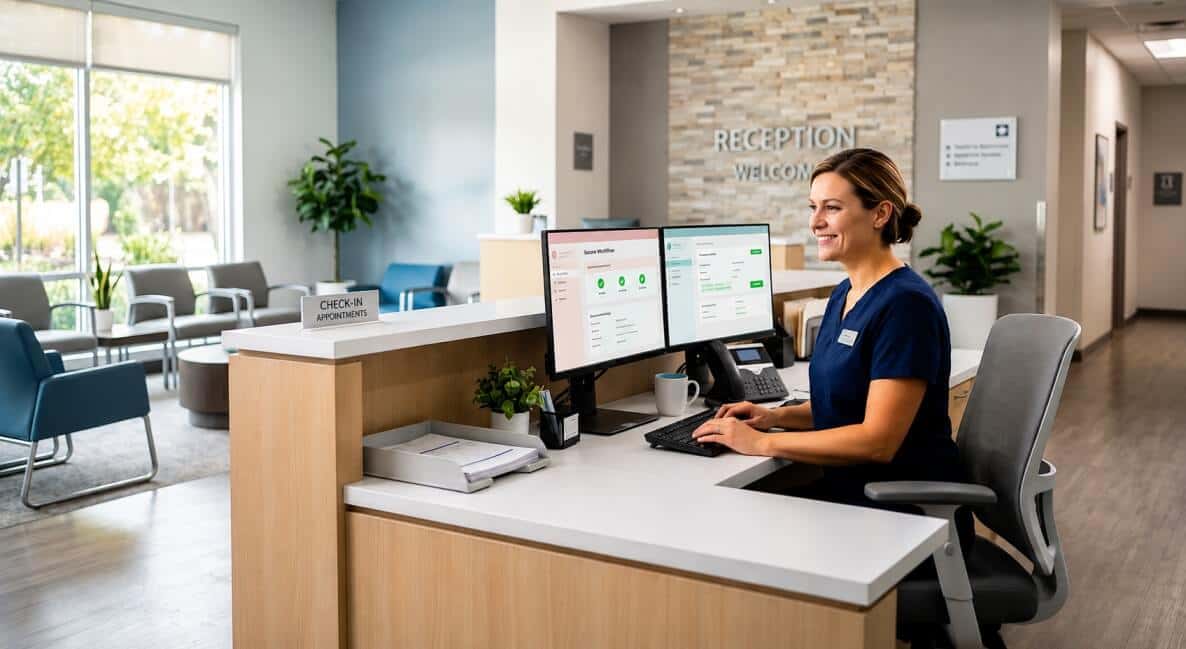
Automated insurance eligibility verification confirms a patient's coverage, benefits, and cost responsibility in real time. It uses AI and payer database connections instead of manual phone calls. Manual checks can take 12+ minutes each.
A front-desk staffer spends twelve minutes on the phone with an insurance payer, only to find out after the visit that the plan lapsed in January. The claim gets denied. The patient gets an unexpected bill. The practice eats the cost of rework.
Automated insurance eligibility verification replaces that manual, error-prone process with a system that checks a patient's coverage in real time, before they ever sit in the waiting room. Practices that adopt it typically see fewer denials, faster payments, and front-desk teams that spend less time on hold with payers.
What Is Automated Insurance Eligibility Verification?
Automated insurance eligibility verification confirms a patient's active insurance coverage, benefits, and financial responsibility. It uses software or AI-driven systems instead of manual phone calls or portal lookups. The system connects directly to payer databases through EDI transactions, APIs, or AI-driven interfaces. From there, it pulls back exactly the details a practice needs before rendering care.
That typically includes:
Active coverage status and effective dates
Co-pay and co-insurance amounts
Deductible status (met or remaining)
Out-of-pocket maximums
Prior authorization requirements for specific services
The difference from manual verification isn't just speed. A trained staffer checking eligibility by phone or portal has to interpret payer-specific language, cross-reference plan types, and manually log what they find. An automated system does that interpretation instantly and consistently, which is where most of the accuracy gains come from.
If your practice is still relying on manual checks, a free eligibility verification audit is the fastest way to see exactly where coverage issues are costing you revenue.
Why Manual Eligibility Verification Keeps Failing Practices
Manual checks aren't just outdated; they're actively costing practices money and time. Here's where the process breaks down.
The Real Cost of Manual Checks
Manual eligibility verification isn't just slow. It's expensive in ways that don't show up on a single line item. Staff time spent on hold with payers is time not spent on patient intake, scheduling, or collections. Multiply a 12- to 16-minute check by dozens of patients a day. That amounts to a meaningful chunk of front-desk labor devoted to a task that adds no direct value to patient care. Source: CAQH Index
Then there's the rework cost. When a manual check misses an inactive policy or a change in plan details, the error doesn't surface until the claim is denied weeks later. At that point, someone has to investigate the denial, contact the patient, resubmit the claim, and wait again. That cycle costs far more than getting it right the first time.
Common Errors in Manual Verification
Most eligibility-related denials trace back to a handful of recurring mistakes:
Outdated coverage information: Patients switch jobs or plans and don't always update the front desk.
Confusing similar plan types: Medicare and Medicare Advantage have different coverage rules and network requirements, and mixing them up is a common, costly error.
Missed secondary insurance: A patient with two active policies but only one on file can lead to incorrect billing order.
Manual data entry mistakes: A transposed policy number or misspelled name is enough to trigger a rejection.
Automated verification removes the guesswork by pulling structured data directly from the payer instead of relying on what a staffer manually types or interprets.
Real-Time vs. Batch Eligibility Verification
One decision practices often overlook is whether they need real-time checks, batch processing, or both. They solve different problems, and picking the wrong one creates unnecessary friction.
Real-time verification runs the check the moment it's needed, usually when a patient books a same-day appointment or walks in unscheduled. It's built for speed and works well for urgent care, walk-in clinics, and practices with high day-of scheduling volume.
Batch verification runs checks in bulk, typically the night before or the morning of a scheduled day, covering an entire day's appointment list at once. This suits practices with predictable, scheduled visits where speed isn't the constraint, but coverage across a whole calendar is.
Practice Type | Recommended Approach |
Urgent care / walk-in clinics | Real-time |
Specialty practices with scheduled visits | Batch (day before) |
High same-day booking volume | Real-time |
Large multi-provider practices | Hybrid (batch + real-time backup) |
Most high-performing practices actually use both: batch processing to clear the bulk of tomorrow's schedule overnight, and real-time checks as a backup for last-minute additions or walk-ins.
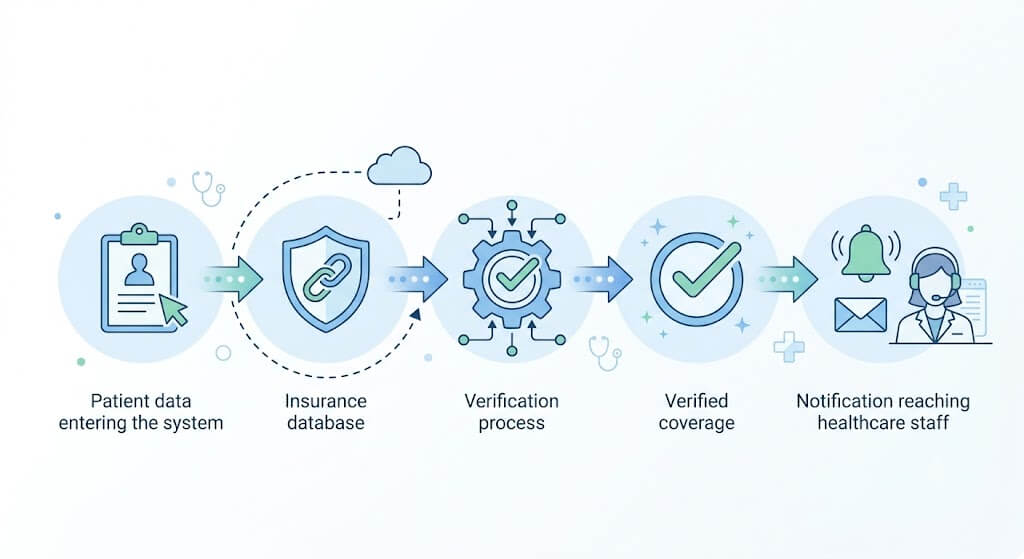
How Automated Eligibility Verification Works, Step by Step
Step 1: Data Intake
Patient demographic and insurance details come in through the scheduling or registration system, either entered by staff or submitted by the patient during online intake.
Step 2: Real-Time Payer Connection
The system connects to the relevant payer through EDI transactions, APIs, or AI-driven interfaces, using whichever method returns the fastest, most reliable result for that specific payer.
Step 3: Data Interpretation and Flagging
Raw payer responses aren't always straightforward. The system interprets the returned data, translating payer-specific codes into plain coverage details, and automatically flags services that likely require prior authorization. Source: American Medical Association
Step 4: EHR/Practice Management Integration
Verified results sync directly into the practice's EHR or practice management system, so staff never have to manually re-enter what was just confirmed.
Step 5: Staff Notification and Patient Estimate
Front-desk staff get a clear summary of coverage, co-pay, and deductible status before the patient arrives. This makes it possible to collect the correct amount at check-in. It also lets practices give patients an accurate cost estimate instead of a surprise bill later.
Eligibility Verification Challenges by Specialty
Eligibility verification isn't one-size-fits-all. Different specialties run into different coverage complications:
Mental health practices often deal with session limits, visit caps, and pre-authorization requirements. That resets differently across plans, making ongoing verification just as important as the initial check.
Orthopedic and surgical practices face layered prior authorization rules, since procedures often require both facility and provider-level approval before a claim can be submitted cleanly.
Primary care practices typically handle high patient volume with more predictable coverage types, which makes batch verification the more efficient fit.
Dermatology practices frequently run into the line between medically necessary and cosmetic procedures. Coverage determination depends heavily on documented diagnosis codes.
A generic eligibility verification process misses these nuances. A system tuned to the specialty catches them before they become denials.

How Eligibility Verification Prevents Denials Downstream
Eligibility verification doesn't operate in isolation. It's the first checkpoint in a chain that determines whether a claim gets paid cleanly or bounces back. Roughly a quarter of all claim denials trace back to eligibility issues that could have been caught before the visit ever happened. Source: KFF
Think of it as front-end prevention versus back-end correction. Fixing a denied claim after the fact means staff time spent investigating, resubmitting, and following up, plus a delayed payment. Catching the same issue during eligibility verification, before the appointment, costs almost nothing by comparison.
Practices that treat eligibility verification as a serious first step in the revenue cycle see the payoff downstream. They get fewer denials and less strain on their billing and denial management teams.
Automated vs. Manual Verification: Cost and ROI
The numbers make the case clearer than any feature list. A manual eligibility check ties up staff time that could otherwise go toward patient-facing work, and every missed or incorrect check risks a denial that costs far more to fix than to prevent.
Factor | Manual Verification | Automated Verification |
Time per check | 12–16 minutes | Under 10 seconds |
Staffing needed | Dedicated front-desk hours | Minimal oversight |
Error rate | Higher, human-dependent | Lower, data-driven |
Denial rework cost | Ongoing, recurring | Significantly reduced |
Scalability | Limited by staff capacity | Scales with patient volume |
Most practices that switch see a return on investment within a few months, driven less by the software cost itself and more by what they stop losing to denial rework and staff time.
Data Security and HIPAA Compliance
Automating a process that touches patient insurance data raises an obvious question: is it secure? A properly built automated eligibility verification system should run on HIPAA-compliant infrastructure. Look for AES-256 encryption, both in transit and at rest.
Any vendor handling this data should also be willing to sign a Business Associate Agreement (BAA). A provider that can't answer basic questions about encryption standards or BAA coverage is a red flag. Take it seriously before handing over patient data.
Choosing an Automated Eligibility Verification Partner
Not all automated verification tools are built the same. When evaluating options, look at:
Payer coverage breadth: Does it connect to the payers your patient base actually uses, including Medicare, Medicaid, and regional commercial plans?
EHR/practice management compatibility: Integration should be seamless, not another manual data-entry step.
Turnaround time: Real-time checks should genuinely be real time, not a euphemism for a few minutes' delay.
Reporting and transparency: You should be able to see verification accuracy, denial reduction, and turnaround metrics, not just take a vendor's word for it.
Human backup: Automation handles the routine cases well, but complex or flagged cases still benefit from a trained team reviewing them.
How long does automated eligibility verification take?
A properly configured system returns results in under 10 seconds for most payers, compared to 12 to 16 minutes for a manual phone or portal check.
Which insurance payers can be verified automatically?
Most automated systems connect to major commercial payers, Medicare, and Medicaid, though exact coverage depends on the specific vendor's payer network.
Does automated verification replace front-desk staff?
No. It removes the repetitive, time-consuming part of the job so staff can focus on patient communication, collections, and handling flagged or complex cases.
What happens if a patient's coverage is inactive?
The system flags it immediately, giving staff time to contact the patient before the appointment instead of discovering the issue after a denied claim.
Is automated eligibility verification HIPAA compliant?
It should be. Look for AES-256 encryption, a signed BAA, and infrastructure built specifically for healthcare data handling.
Conclusion
Manual eligibility verification was never designed to keep up with today's claim volume, payer complexity, or patient expectations. Automated insurance eligibility verification fixes the problem at its source, catching coverage issues before a claim is ever submitted, not after it bounces back. For practices dealing with recurring eligibility-related denials, it's one of the highest-impact changes available in the revenue cycle.
Related Posts
Ophthalmology Medical Billing Services: Costs, Coding Pitfalls, and How to Choose the Right Partner

Oncology Billing Services: How They Work, What The Cost Is, and How to Choose the Right Partner in 2026

What Are Community Rehabilitation Companies? A Complete US Guide to Types, Funding & Billing
Comments (0)
Comments are disabled for this post.