

Learn how payment posting works in medical billing, from ERA and EOB processing to underpayment detection, patient responsibility, and payment reconciliation.
Payment posting is the process of recording payments from insurance companies and patients into a medical billing system. It updates each claim balance and reflects what was actually reimbursed. The process starts with reviewing the remittance advice, verifying payment details, and then posting the amount to the correct claim and account.
Billing teams rely on different posting methods depending on their workflow. These include manual posting, electronic ERA posting, and fully automated posting through billing software. Each method affects how quickly and accurately payments get recorded.
This step demands close attention because errors are common. Manual entry mistakes, ERA-EOB mismatches, and complex payer adjustments all create risk. Billing teams must also catch underpayments and overpayments early, so claims stay reimbursed correctly, and patient balances remain accurate.
What Is Payment Posting in Medical Billing?
Payment posting in medical billing means recording payments, adjustments, and denials into your billing system. It happens after a payer processes a claim. Every dollar gets logged, matched, and reconciled against the original charge.
This step sits right after claim adjudication. It comes before accounts receivable follow-up and patient billing. Without accurate posting, your A/R numbers mean nothing.
People sometimes confuse payment posting with charge posting. Charge posting happens before a claim is submitted. Payment posting happens after the payer responds. They're opposite ends of the same claim's lifecycle.
Done well, payment posting gives you a clear financial snapshot. Done poorly, it hides problems until they compound. That's why experienced billing teams treat this step as more than data entry. Source: Medical Economics
EOB vs. ERA: The Two Documents Payment Posting Relies On
You can't post payments without source documents. Two formats dominate: EOBs and ERAs. Knowing the difference matters for both accuracy and speed.
What Is an EOB (Explanation of Benefits)?
An EOB is a paper or PDF statement from the payer. It outlines what was billed, what was covered, and what the patient owes. Staff must read it manually and enter the numbers by hand.
EOBs are common with smaller payers or older systems. They work fine, but they're slow. Every field has to be typed, which increases the risk of a mistake.
What Is an ERA (Electronic Remittance Advice) / 835 File?
An ERA is a standardized electronic file, formatted as an 835 transaction under HIPAA. It carries the same information as an EOB, but in a structured, machine-readable format.
Billing software can import an ERA directly. This removes most manual entry and speeds up the entire posting cycle. Fewer typed fields also means fewer errors.
Key Differences and Why ERA Is Becoming the Standard
EOBs require manual reading and re-entry. ERAs load automatically into your system, matched to open claims. Most modern practices now prioritize ERA enrollment with every payer they work with.
The shift toward ERA isn't just about convenience. It directly reduces posting turnaround time and cuts down on transcription errors. That combination protects both cash flow and staff hours. Source: DrChrono
The Payment Posting Process, Step by Step
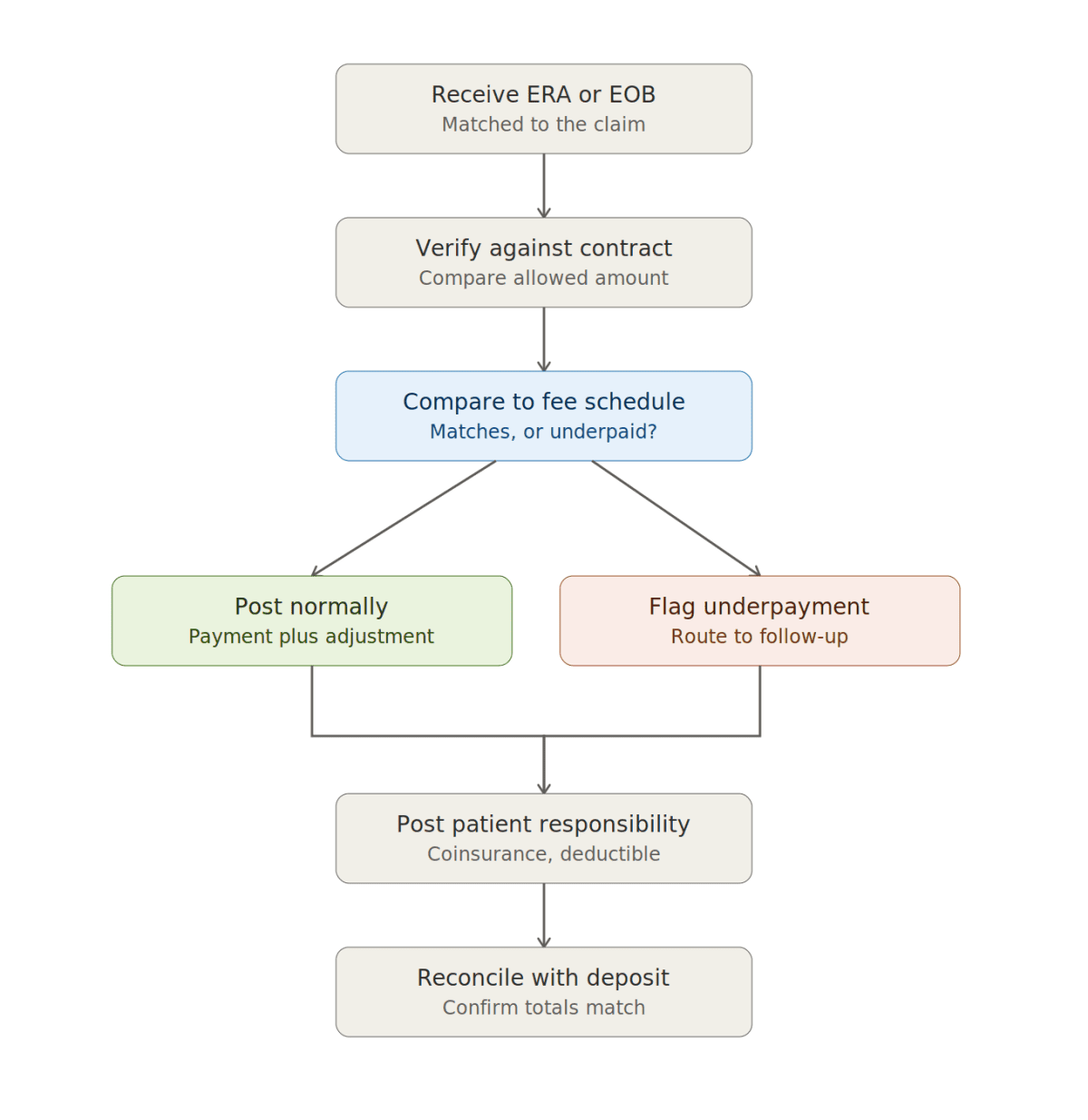
The process follows a consistent sequence, regardless of practice size. Skipping a step almost always creates downstream cleanup work later.
Step 1: Receiving the ERA or EOB
The cycle starts when the payer sends its response. This could be an ERA file loaded automatically, or a paper EOB routed to a biller. Either way, the document gets matched to its original claim.
Step 2: Verifying Payment Against the Contracted Rate
Before anything gets posted, someone checks the payment against the provider's contracted rate. This step catches issues early, before they're buried under other entries. Skipping it is how underpayments slip through.
Step 3: Comparing to the Fee Schedule
Here, the biller confirms whether the paid amount matches what the fee schedule allows. If it matches, posting continues normally. If it doesn't, the claim gets flagged for further review.
Step 4a: Posting Normally
When the payment matches expectations, posting proceeds as usual. The payment amount, contractual adjustment, and any remaining balance get entered against the claim.
Step 4b: Flagging and Routing Underpayments
When the payment falls short, the claim gets routed to a separate underpayment workflow. This keeps it from being silently written off as a normal adjustment.
Step 5: Posting Patient Responsibility
Coinsurance, deductibles, and copays get posted to the patient's account. This generates the balance that will eventually appear on a patient statement.
Step 6: Reconciling with the Bank Deposit
Finally, the total posted amount is checked against the actual deposit received. If the numbers don't match, something in the process needs a second look.
Understanding CARC and RARC Codes in Payment Posting
Every ERA comes loaded with codes. These codes explain exactly what happened to a claim, and they tell your team what to do next.
What CARC Codes Tell You
Claim Adjustment Reason Codes explain why a payment differs from the billed amount. A CARC might indicate a contractual write-off, a missing authorization, or a non-covered service. Each code points to a specific financial reason.
What RARC Codes Add
Remittance Advice Remark Codes add context to a CARC. Where a CARC says a claim was denied, a RARC often explains the exact reason or next step. Together, they tell the full story behind a payment. Source: American Medical Billing Association
Common Codes Billers See Daily
Code | Meaning | Posting Action |
CO-45 | Charge exceeds fee schedule | Write off as contractual adjustment |
CO-97 | Service bundled into another paid procedure | Verify bundling, then adjust |
CO-16 | Claim lacks required information | Route to correction and resubmission |
PR-1 | Patient deductible amount | Bill to patient |
PR-2 | Patient coinsurance amount | Bill to patient |
OA-23 | Payment adjusted by prior payer | Confirm coordination of benefits |
Reading these codes correctly is what separates fast, accurate posting from guesswork. A misread code can send a balance to the wrong place entirely.
Underpayment vs. Contractual Adjustment: How to Tell the Difference
This distinction is where practices either protect their revenue or quietly lose it. The two look similar on paper but mean very different things.
What Counts as a Legitimate Contractual Write-Off
A contractual adjustment is expected. It reflects the gap between what a provider charges and what the payer's contract allows. This amount should never be billed to the patient, and it isn't lost revenue.
How to Spot a True Underpayment
An underpayment happens when the payer reimburses less than the contract actually specifies. This isn't visible unless someone checks the payment against the real fee schedule, not just the payer's stated allowed amount.
What to Do When You Find One
Once identified, an underpayment should be documented and appealed. Waiting too long can mean missing the payer's appeal deadline entirely. A dedicated underpayment log helps teams track these cases to resolution.
Manual vs. Automated Payment Posting
Both approaches have a place, and most practices end up using a mix of the two.
How Manual Posting Works and Its Limitations
Manual posting means a staff member reads each EOB and enters the data by hand. It works, but it's slow and prone to typos. Larger claim volumes make manual posting increasingly impractical.
How Auto-Posting Software Works
Auto-posting software reads ERA files and posts payments automatically, matching them to open claims. This dramatically speeds up the process and reduces basic data entry mistakes.
What Automation Still Can't Catch
Software can't verify whether a payer paid correctly against your actual contract. It posts what the ERA says, without questioning it. Human review is still needed to catch underpayments and contract violations.

Common Payment Posting Errors and Their Financial Impact
Small mistakes at this stage create outsized problems downstream.
Error | Why It Happens | Downstream Cost |
Misapplied patient payment | Wrong account selected during entry | Incorrect patient balance, billing disputes |
Duplicate ERA import | File imported twice by mistake | Overstated revenue, reconciliation errors |
Wrong adjustment code used | Similar codes confused during entry | Misrepresented denial or write-off data |
Unposted secondary payer balance | Claim not routed to next payer | Delayed reimbursement, lost revenue |
Each of these errors compounds over time. A single missed secondary claim might seem minor, but multiplied across hundreds of claims, it adds up fast.
How to Measure Payment Posting Quality
Numbers tell you whether your posting process is actually working.
Posting Accuracy Rate
This tracks the percentage of postings entered without error. A high rate signals a well-trained, careful team.
Days to Post from Receipt
This measures how quickly payments are posted after receipt. Delays here slow down the entire revenue cycle.
Unapplied Cash Percentage
This shows how much received money hasn't yet been matched to a claim. A high percentage usually points to unresolved reconciliation issues.
Denial-Identification Rate at Posting
This tracks how many denials get caught during posting itself, rather than later. Catching them early speeds up appeals and resubmissions.
Payment Posting for Secondary and Tertiary Insurance (Coordination of Benefits)
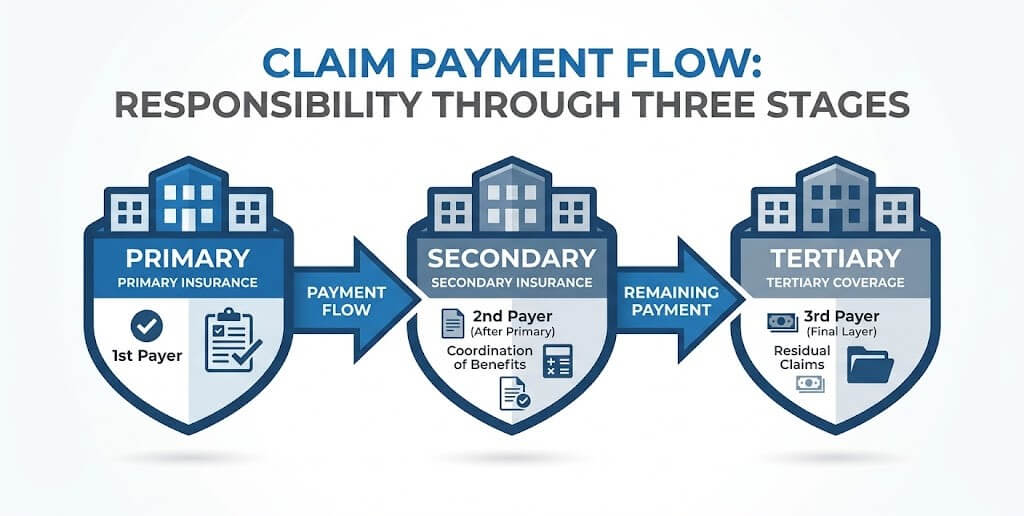
Coordination of benefits applies when a patient has more than one insurance plan. Payments arrive from each payer separately, often days or weeks apart. Posting has to reflect the correct order every time.
How the Payment Sequence Works
The primary payer processes the claim first, based on standard COB rules. Common rules include the birthday rule for dependents and specific employer-vs-retiree guidelines. Once the primary payer responds, that payment gets posted first.
The remaining balance then moves to the secondary payer. This claim must include the primary payer's EOB or ERA details. Without this information, the secondary payer will likely deny the claim outright.
If a tertiary payer exists, the same process repeats. Each payer only covers what's left after the previous payer's response. Posting must track this chain accurately, claim by claim.
Why This Step Gets Complicated
Different payers apply different rules for determining primary versus secondary coverage. A biller has to confirm the correct order before posting anything. Getting this wrong creates delayed payments and avoidable denials.
Government payers add another layer. Medicare and Medicaid crossover claims often forward automatically to the secondary payer. Billing teams still need to verify these transfers, since automated crossovers sometimes fail silently.
Best Practices for Posting COB Claims
Always confirm the patient's coverage order at each visit, not just at intake. Insurance priority can change without the practice being notified in advance.
Keep a clear paper trail for every payer in the chain. Each EOB or ERA should be attached to its claim, showing exactly what was covered and adjusted. This documentation matters if a payer later disputes the payment order.
Train staff to flag claims stuck in COB limbo. A claim sitting unresolved between payers for too long often signals a documentation gap. Catching this early prevents it from aging into a write-off.
If you're unsure which fits your practice, a free billing audit can help clarify where posting currently stands.
What documents are needed for payment posting?
Payment posting requires either an ERA file or a paper EOB from the payer. Both contain the payment details, adjustment codes, and patient responsibility amounts needed for accurate posting.
How long should it take for payment to post after a claim is paid?
Best practice is posting within 24 to 48 hours of receiving the ERA or EOB. Longer delays slow down patient billing and hide potential issues.
What's the difference between payment posting and charge posting?
Charge posting happens before a claim is submitted, recording what was billed. Payment posting happens after the payer responds, recording what was actually paid.
Can payment posting affect denial rates?
Yes. Payment posting is often the first place denial patterns become visible. Catching them early allows billing teams to address root causes faster.
Related Posts

Ophthalmology Medical Billing Services: Costs, Coding Pitfalls, and How to Choose the Right Partner

Oncology Billing Services: How They Work, What The Cost Is, and How to Choose the Right Partner in 2026

What Are Community Rehabilitation Companies? A Complete US Guide to Types, Funding & Billing
Comments (0)
Comments are disabled for this post.